In Brighton, a Welsh slate roof lasts 80–100+ years, clay plain tile 60–100 years, and concrete interlocking tile 30–50 years. Coastal salt air shortens the life of concrete tile and lead most, while clay and slate are largely unaffected — giving period properties a longevity advantage.
Roof Lifespans in Brighton — Material by Material
Welsh Slate: 80-100+ Years
Welsh slate is the longest-lasting roofing material in use in Brighton. The Regency and early Victorian properties of Brunswick, Kemp Town and the central avenues were originally slated, and many still retain their original slate in good condition after 150-170 years. The slate itself rarely fails — it's the mortar, nails and lead that need periodic attention. Salt air has minimal effect on slate.
A well-maintained Welsh slate roof in Brighton should comfortably last 100 years. The cost premium over concrete tile is significant upfront but negligible over the full lifespan of the material.
Clay Plain Tile: 60-100 Years
Clay plain tile is the dominant material on Brighton's Victorian and Edwardian stock — the terraces of Hanover, Preston Park, Fiveways and the Poets Corner Edwardians all have it. A roof that is 100-130 years old and still performing well is not unusual in Brighton. The tile doesn't fail; the mortar on the ridges and hips softens after 80-100 years, and the original wire nails corrode through after 70-90 years. But the tile itself has decades of life left.
The practical implication: on a Victorian Brighton terrace, the right approach is usually repair and maintenance rather than replacement. The tiles are fine. The infrastructure around them — mortar, lead, fixings — needs periodic renewal.
Concrete Interlocking Tile: 30-50 Years
Concrete interlocking tile is the dominant material on Brighton's post-war and inter-war suburban expansion — Moulsecoomb, Hollingbury, Whitehawk, Burgess Hill, and the vast bungalow stock of Saltdean and Peacehaven. The design life is 30-50 years. In Brighton's coastal conditions, the lower end is more typical for exposed positions.
The problem: Brighton has enormous quantities of concrete tile that is now 60-90 years old — double its intended life. The Saltdean and Peacehaven inter-war bungalows have tile from the 1930s-50s that is 70-90 years old. The nails corroded decades ago. The tile itself is carbonating. These roofs are structurally at end of life even if they appear intact from ground level.
GRP Fibreglass Flat Roofing: 30-40 Years
GRP correctly installed and maintained lasts 30-40 years in Brighton's coastal UV and humidity. This is significantly longer than felt (8-12 years) and somewhat longer than EPDM (20-30 years in coastal conditions). For the rear extensions of Brighton and Hove's Victorian, Edwardian and inter-war stock, GRP is the material that ends the cycle of repeated flat roof replacement.
Traditional Felt: 8-12 Years
Three-layer bitumen felt has a short life in Brighton's conditions. The combination of coastal UV, salt air and the south-facing exposure typical of Brighton rear extensions means felt that might last 12-15 years inland often fails at 8-10 years here. It's still installed on new builds and extensions but we recommend GRP for any replacement job where longevity is the priority.
Key fact: Natural Welsh slate carries a BBA-assessed durability of over 100 years, the longest service life of any common UK roofing material — confirmed by the many original slate roofs still performing on Brighton's Regency and early Victorian stock.
What Reduces Roof Lifespan
Beyond material choice, three things cut roof life significantly:
- Poor installation — incorrect mortar mixes, inadequate nail fixing, wrong lead code, poor drainage falls on flat roofs. The biggest single factor in premature failure.
- Deferred maintenance — a blocked valley costs £80 to clear and £800 to repair if left until water damage is done. Mortar that needs repointing at £300 becomes a re-ridge at £600 if ignored for ten years.
- Inappropriate repair materials — cement mortar on Victorian brickwork, patching products on failing lead, foam sealant in valleys. These are cheap short-term fixes that cause expensive long-term problems.
Practical Inspection Schedule for Brighton Properties
Given Brighton's coastal conditions, we recommend:
- Annual: Clear gutters and valleys — autumn and spring minimum
- Every 5 years: Professional roof-level inspection — check lead, mortar, nail condition on tiles, flat roof membrane condition
- After any major storm: Ground-level check for displaced tiles or ridge pieces; loft inspection for new daylight or damp
- At property purchase: Insist on a roof-level survey as part of due diligence — surveyor reports rarely include roof-level access
We carry out free surveys across Brighton and East Sussex. Call 01273 973 996 to arrange.
The Short Version
- Lifespan depends on material: slate 80–100+ years, clay 60–100, concrete 40–60, felt flat roofs 10–20.
- Brighton’s coastal exposure shortens every figure versus inland — salt, wind and UV all take a toll.
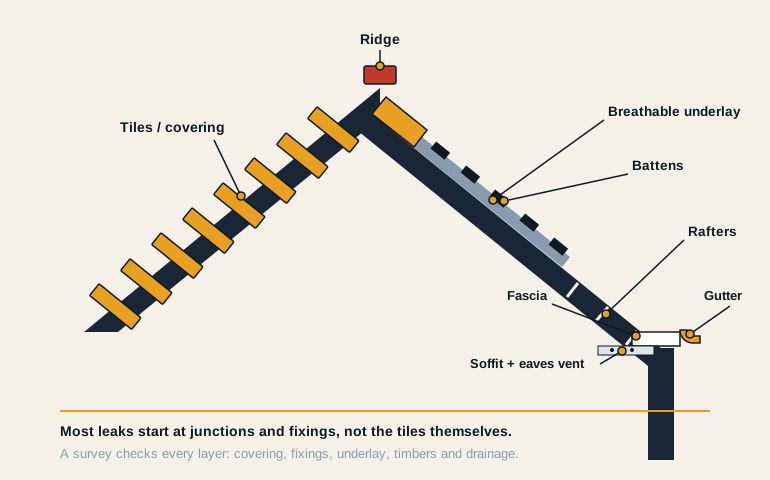
- Fixings and flashing often fail before the covering, so a roof can ‘fail’ while the tiles are still sound.
- Regular clearing, prompt small repairs and good ventilation all extend a roof’s life.
- A twice-yearly check catches the small problems that otherwise shorten a roof’s life.
Getting the Right Roofer for This Job
The quality difference between roofing contractors in Brighton is significant — not just in price but in knowledge, specification and materials. For any job involving conservation area materials, lime mortar on Victorian properties, code 5 lead in coastal positions, or nail sickness assessment on older concrete tile, you need a roofer with specific experience of Brighton's housing stock.
The right way to assess a roofer for your job: ask specifically about their experience with your property type and the specific work required; ask for references from comparable recent jobs you can call; verify NFRC registration independently at nfrc.co.uk; get a written quote that specifies materials, not just a price.
What to Ask Before You Book
- Have you done this type of work on similar properties in Brighton?
- What mortar specification do you use on Victorian properties? (Answer should be lime)
- What lead code do you specify for this position? (Code 5 for exposed coastal)
- Can you provide references from similar recent jobs?
- Is your NFRC registration current? (Verify at nfrc.co.uk)
- What does the written guarantee cover and for how long?
We carry out free surveys across Brighton and East Sussex. Call 01273 973 996 to arrange.
Frequently Asked Questions
Clay plain tile correctly installed and maintained lasts 60-100 years in Brighton's coastal conditions. Many Victorian terraces in Hanover, Preston Park and the Avenues still have their original 1880s-1900s clay tile in good structural condition. The mortar, lead and ridge work needs periodic attention, but the tile itself rarely fails first.
Concrete interlocking tile has a design life of 30-50 years. In Brighton's coastal conditions, expect the lower end — many 1960s-70s concrete tile roofs are now showing nail sickness and mechanical tile failure at 50-60 years old. The inter-war bungalow stock of Saltdean and Peacehaven has concrete tile that is now 70-90 years old and largely at end of life.
Yes, for some materials. Lead flashing corrodes 30-40% faster in coastal salt air than inland. EPDM lap joints fail sooner. Mortar on exposed south-facing elevations softens faster. Clay and Welsh slate tile are relatively unaffected by salt — their longevity advantage over concrete tile is even greater in coastal conditions.
Welsh slate, followed by clay plain tile. Welsh slate on a well-maintained Brighton property can last 100+ years. Clay plain tile lasts 60-100 years. Both significantly outperform concrete interlocking tile (30-50 years) in Brighton's coastal conditions.
By material: natural slate 80–100+ years, clay tile 60–100, concrete tile 40–60, and felt flat roofs 10–20 (longer for GRP or EPDM). Brighton’s coastal salt, wind and UV tend to pull each figure toward the lower end versus a sheltered inland roof, so local exposure matters as much as the material.
On the coast: salt corrosion of fixings and flashing, wind lifting tiles, UV embrittling flat-roof coverings, and trapped moisture from poor ventilation or heavy moss. Neglect compounds all of them — a single slipped tile left alone lets water into the battens and felt, ageing the roof from within.
Yes. Keep gutters and valleys clear, deal with slipped tiles and small leaks promptly, keep moss in check, and make sure the roof is ventilated so moisture doesn’t rot the timbers. None of it is expensive — and on the coast, where roofs work harder, that basic upkeep noticeably extends their life.
Widespread slipped or cracked tiles, sagging areas, daylight or damp in the loft, failing flashing at several points, and repairs becoming frequent all point that way. On a Brighton roof, once you’re paying for repeated repairs the honest question is whether that money is better put toward replacement — which a free survey can settle.
Last reviewed: 21 July 2026 · Brighton Roofing Experts