Nail sickness is the corrosion of the metal nails fixing roof tiles to the battens, causing tiles to slip even though the tiles themselves are intact. It is common in Brighton because coastal salt air accelerates nail corrosion, and much of the city's concrete-tile housing predates modern stainless fixings.
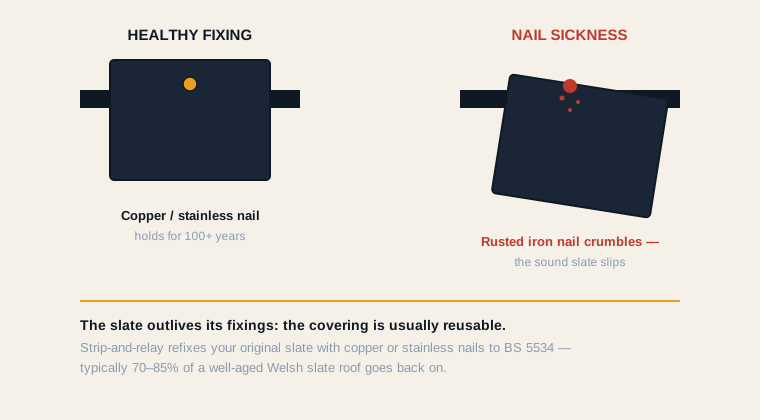
What Is Nail Sickness?
Roof tiles are fixed to horizontal timber battens using nails driven through the tile nib — the small ridge on the back of each tile that hooks over the batten. In construction from roughly the 1930s through to the early 1980s, these nails were typically mild steel wire nails. Mild steel corrodes when exposed to moisture over decades. Eventually, the nail corrodes so badly that it snaps, leaving the tile resting on the batten with no mechanical fixing.
A tile with nail sickness is held in place by: gravity (pulling it down against the batten), friction against the tiles on either side, and the weight of the tile above it (on double-lap systems). In normal conditions, this is often enough to keep a tile in place indefinitely. In high winds — and Brighton's coastal position means regularly high winds — the wind uplift force can exceed the gravitational retention, and tiles lift off.
Key fact: BS 5534 now requires every tile on a roof to be mechanically fixed, a standard introduced after research showed original single-nail and clip patterns failed prematurely — which is precisely the failure mode seen across Brighton's older concrete-tile estates.
Why Brighton Has More Nail Sickness Than Inland Towns
Two factors make nail sickness more prevalent in Brighton and coastal East Sussex than in equivalent inland towns:
1. The Age of the Stock
Brighton's housing growth phases produced large quantities of housing in the periods most associated with mild steel nail fixings. The inter-war bungalow stock of Saltdean and Peacehaven — built from the 1920s to 1950s — is now 70-100 years old. The post-war council and private estates of Hollingbury, Moulsecoomb, Whitehawk and the Burgess Hill expansion estates — built in the 1950s-70s — are now 50-70 years old. In both cases, the nails are well past the age at which corrosion becomes structurally significant.
2. Coastal Moisture Accelerates Corrosion
Mild steel corrodes faster in high-humidity, salt-laden air than in the relatively dry air of inland towns. Brighton's proximity to the English Channel means the battens and fixings are exposed to higher moisture levels and salt particulates than equivalent properties in Surrey, Hampshire or Berkshire. The result is that nails corrode to failure 10-20 years sooner than they would inland — pushing nail sickness into properties that have only been standing for 40-50 years, rather than the 60-80 years more typical inland.
The insidious thing about nail sickness is that it's invisible from ground level. A roof with 40% of its tiles no longer mechanically fixed can look completely normal in calm conditions — neat, even rows, no obvious gaps. The first indication is often a tile on the path after a gale. By then, the problem has typically been building for years.
How to Tell If Your Roof Has Nail Sickness
From ground level, the signs are subtle:
- Tiles that appear very slightly higher or lower than adjacent tiles (the lack of mechanical fixing allows small movements)
- Tiles visible rocking slightly in strong wind
- A history of losing the occasional tile in storms without obvious impact damage
- A property built in the 1930s-70s with no re-roofing history
From roof level, nail sickness is straightforward to identify: an experienced roofer will check tiles by hand, feeling for the movement that indicates a failed nail. We include a nail sickness assessment as standard in every survey we carry out on properties built before 1980.
What to Do About Nail Sickness
Localised Nail Sickness: Repair
When nail sickness is confined to a section of roof — a particular slope, or tiles adjacent to a chimney or valley — systematic repair makes sense. Each affected tile is lifted, the old corroded nail removed, and the tile refixed with a copper or stainless steel nail that will not corrode for the life of the roof. From £150 for a small area, rising to £800-£1,500 for a complete slope.
Widespread Nail Sickness: The Calculation
When nail sickness affects 30-50%+ of tiles, the repair cost approaches or exceeds re-roofing cost for the whole roof. At this point we will run through the 10-year cost calculation honestly: if systematic refixing costs £1,800 and re-roofing costs £7,000, the repair is clearly better value even on a 10-year horizon. If refixing costs £4,500 and the tiles are also mechanically failing (carbonating), re-roofing at £7,000 is often the right answer.
We carry out free surveys across Brighton and East Sussex. Call 01273 973 996 — or see our Saltdean, Peacehaven and Burgess Hill pages for more on the specific nail sickness issues in these areas.
Nail Sickness by Brighton Neighbourhood
Nail sickness is not uniformly distributed across Brighton's housing stock. It is concentrated in specific neighbourhoods where the combination of age and construction method has created near-universal failure of original mild steel nail fixings.
Saltdean and Peacehaven: The Most Affected Areas
The inter-war grid developments of Saltdean and Peacehaven, built from the 1920s through the 1950s, have concrete interlocking tile stock that is now 70-100 years old. The original mild steel wire nails corroded through decades ago on most properties. The tiles on the oldest Peacehaven properties are held by gravity and the weight of adjacent tiles — nothing else. A roof that looks perfectly normal from the street may have 80% of its tiles unfixed.
This is not a minor maintenance issue. In the south-westerly gales that hit these cliff-top properties multiple times each winter, unfixed tiles are at risk of cascade displacement — one tile goes, the tiles that were wedged against it follow, and a small gap becomes a large hole within hours. We carry out free nail sickness assessments across Saltdean and Peacehaven and give clear written advice on the repair vs replacement decision.
Moulsecoomb, Hollingbury and Whitehawk: The Post-War Estates
Brighton's major post-war council estates were built from the 1940s through the 1970s. The earlier estates — Moulsecoomb and Whitehawk — have the oldest stock, with 1940s-50s concrete tile now 70-80 years old. The 1960s-70s Hollingbury stock is somewhat younger but elevated at 80-100m above sea level, where frost-accelerated nail corrosion has advanced the timeline significantly compared to equivalent sea-level properties.
On these estates, nail sickness assessment should precede any significant repair expenditure. Spending £600 on ridge repointing on a property where 60% of the tiles are unfixed is not addressing the actual risk — it's addressing a symptom while the structural problem remains.
Frequently Asked Questions
Nail sickness is where the wire nails used to fix roof tiles to battens have corroded and snapped through age and moisture. The tiles are then held only by their own weight and friction against surrounding tiles. The roof can look perfectly normal from ground level while a significant proportion of tiles are no longer mechanically secured.
Signs include: tiles that rattle or shift slightly in wind; slightly uneven lines in the roof plane visible from ground level; a roofer finding loose tiles when walking the roof; a property built in the 1960s-80s with no re-roofing history. The only definitive way to assess is a roof-level inspection — we carry these out for free across Brighton.
It can be. Tiles held only by gravity will come off in high winds — a risk to anyone below and to the property. In Brighton's exposed coastal position, where Channel gales regularly exceed 50mph, nail-sick roofs are more at risk than equivalent inland properties. It's also a waterproofing risk: loose tiles create gaps in the weather seal even before a tile falls.
Individual nail sickness repair (refixing loose tiles with copper or stainless steel nails) costs from £150-£400 for localised areas. When nail sickness is widespread, systematic refixing of the whole roof costs £800-£2,500 depending on size. When it's near-universal and the tiles are also mechanically failing, re-roofing is often more cost-effective.
Last reviewed: 21 July 2026 · Brighton Roofing Experts