Clay vs Concrete Tiles: Which Should You Choose in Brighton?
Where a Brighton roof is tiled rather than slated, the choice is usually clay versus concrete. Both are proven pitched-roof coverings; the differences that matter locally are colour longevity, weight and cost — and Brighton's salt air tips a couple of them.
Tell us the job in 30 seconds. No pushy sales, no call-out fee.
20+
Years Local
127
5★ Reviews
24/7
Emergency
10yr
Guarantee
Clay tiles cost more but hold their colour for generations and suit Brighton's period and coastal stock; concrete tiles are cheaper and strong but fade over time, faster in salt air. For long-term looks choose clay; for lowest cost on modern homes, concrete does the job.
✓ NFRC Registered
✓ Fully Insured
✓ 10 Year Guarantee
✓ Free Quotes
✓ No Hidden Costs
✓ Coastal Specialists
At a glance
Clay Tiles vs Concrete Tiles: Side by Side
Where a Brighton roof is tiled rather than slated, the choice is usually clay versus concrete. Both are proven pitched-roof coverings; the differences that matter locally are colour longevity, weight and cost — and Brighton's salt air tips a couple of them.
Neither is simply ‘better’ — each wins in different situations, and the table below sets the two side by side before we get into detail and what each means for a Brighton roof specifically.
Aspect
Clay Tiles
Concrete Tiles
Typical lifespan
60–100 years
40–60 years
Installed cost (indicative)
£70–£120/m²
£50–£90/m²
Colour over time
Fired-in — holds for generations
Surface pigment — fades, esp. in salt air
Weight
Moderate
Heavy — check structure on re-roof
Look
Traditional, ages gracefully
Broad range; can look flatter
Strength
Can be more brittle
Very strong; impact-resistant
Moss/porosity
Low porosity when glazed
More porous — holds moss/algae
Period fit
Suits older Brighton stock
Common on post-war estates
Clay Tiles
Clay Tiles
Where clay is right
Clay tiles are fired, so their colour runs through the tile and lasts as long as the tile does — 60 to 100 years without fading. They suit Brighton's period and traditional homes, weather gracefully, and their low porosity means less moss and algae take hold. If you want a roof that still looks right in forty years, clay is the choice.
The trade-offs
They cost more than concrete and can be a little more brittle underfoot, so careful handling and fixing matter. On an exposed Brighton roof, correct fixing to BS 5534 is essential whichever tile you pick.
Clay for the long view
If you're staying put or you care how the roof looks in twenty years, clay is the tile that keeps its face — the colour is fired through, so it doesn't fade, streak or go patchy the way a coated concrete tile can. On a traditional or coastal-facing Brighton home, that longevity of looks is often what tips the decision.
Concrete Tiles
Concrete Tiles
Where concrete is right
Concrete tiles are cheaper, very strong and come in a huge range, which is why they blanket Brighton's post-war estates. For a cost-led re-roof on a modern home they're hard to beat, and they shrug off impact well.
The trade-offs
Their colour is a surface pigment that fades over years — noticeably faster in Brighton's salt-laden air — and they're heavy, so on a re-roof we check the structure can take them. Being more porous, they tend to hold moss and algae, so a coastal concrete roof often needs cleaning sooner.
Concrete done well
Concrete tile isn't a compromise when it's the right call — on a modern estate home it's strong, quick to lay and decades-durable, and a good interlocking concrete tile sheds water well. The key is accepting the trade of some fading for a lower price, and making sure the structure carries the extra weight.
Honest advice
Which Is Right for You?
It comes down to how long you want the look to last and what your budget and structure allow — we'll advise for your specific roof.
Choose clay for long-term, fade-free looks on period, traditional or coastal-facing Brighton homes.
Choose concrete for the lowest cost and maximum strength on modern stock, accepting some fading over time.
On a re-roof, we check the roof structure can carry heavier concrete tiles before recommending them.
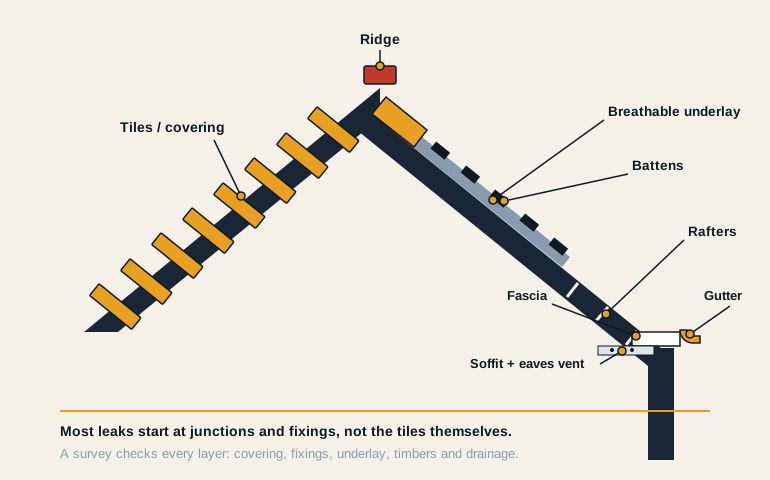
The layers of a pitched roof — most leaks start at junctions and fixings, not the tiles.
Local knowledge
Clay Tiles vs Concrete Tiles in Brighton
On Brighton's post-war estates concrete tile is the norm, while clay and slate dominate the older, central and conservation stock. Brighton's salt air is the local wrinkle: it accelerates the fading of concrete's surface pigment and encourages moss on more porous tiles, so a south-facing coastal roof in clay tends to keep its looks longer. In conservation areas the council may steer you toward clay or slate over concrete — we'll flag what applies.
On a coastal-facing Brighton roof the salt air is the quiet decider: it fades concrete's surface pigment faster and helps moss colonise more porous tiles, so a south- or sea-facing slope in clay tends to keep its looks and stay cleaner for longer. Inland-facing and sheltered roofs feel this less, which sometimes makes concrete the sensible economy there.
Costs
Clay Tiles vs Concrete Tiles: What It Costs in Brighton
Aspect
Clay Tiles
Concrete Tiles
Re-tile one slope
£2,000–£3,800 (clay)
£1,800–£3,200 (concrete)
Full re-roof, terraced
£5,500–£10,000 (clay)
£4,500–£9,000 (concrete)
Individual tile replacement
Match & swap
Match & swap
Cost-per-year (rough)
Lower over the long run
Lower upfront, shorter life
Indicative Brighton pricing including battens, membrane and fixing to BS 5534. Every quote follows a free survey. No deposit; staged payments, nothing before materials are on site.
What affects your quote
The tile itself — clay costs more per m² than concrete
Roof structure — heavier concrete may need checking or reinforcement
Roof size, pitch, height and scaffold
Matching an existing tile on a repair or partial re-roof
Underlay, battens and any timber repair beneath the tiles
How we fit it
What to Expect When We Do the Work
A tile re-roof runs the same either way: a free survey of the covering, timbers and structure, a fixed written itemised quote, scaffold, strip, any batten or timber repair, new membrane and the matched tile fixed to BS 5534 — finished with a clean site and a written 10-year workmanship guarantee.
The bottom line
The Bottom Line for Brighton
For a Brighton home where looks matter long-term — or a coastal-facing slope — clay is the tile that keeps its face and stays cleaner. For a budget-led re-roof on a modern, sheltered home, concrete is strong and sensible if the structure carries it. We survey the roof, the structure and the aspect, and recommend the tile that fits your home and your budget.
FAQ
Frequently Asked Questions
Yes — clay typically lasts 60–100 years against concrete's 40–60, and clay keeps its colour throughout while concrete's surface pigment fades. Over the life of the roof clay often works out better value despite the higher upfront cost.
Their colour is a surface coating rather than fired through the tile, so UV and weathering wear it down over the years. In Brighton the salt-laden coastal air speeds that up, which is why older concrete roofs here can look patchy and tired.
They're heavier than clay, so on a re-roof — especially swapping from slate — we check the timbers can carry the load before recommending them. If reinforcement is needed we'll say so; sometimes clay or a lightweight tile is the better answer.
Concrete, generally — it's more porous, so moss and algae take hold more readily, and Brighton's damp coastal air doesn't help. Glazed clay sheds growth better. Either way, we can treat and clean a mossy roof; see our moss removal service.
We always match the existing tile — type, profile and colour — so a repair blends in. Mixing clay and concrete on one roof looks wrong and can cause fixing issues, so we source the right match rather than whatever's to hand.
Often clay or slate rather than concrete — Brighton & Hove City Council may expect a traditional covering on period and conservation-area roofs. We'll tell you what's likely to be acceptable for your address before you commit.
If you want the best long-term looks and don't mind the higher upfront cost, yes. On a purely budget-led re-roof of a modern Brighton home, concrete is the pragmatic choice and will still last decades.
Usually yes — clay is generally lighter than concrete, so structurally it's rarely a problem, and it's a common upgrade for the looks and longevity. We check the battens and timbers at survey and confirm the detail before quoting.
Both are low-maintenance, but concrete's greater porosity means a coastal Brighton concrete roof tends to grow moss sooner and may want cleaning every few years. Glazed clay sheds growth better. Either way, keeping gutters clear and moss in check is the main upkeep.
The honest way is a free survey. We look at your actual Brighton roof — its size, condition, pitch, aspect and setting — and recommend the option that genuinely fits, in writing, with both costed if it's a real choice. There's no obligation to book the work, and we'd rather you chose right than chose dear.