A clear, honest breakdown of what a new roof costs in Brighton in 2026 — by property type, by material, and with the coastal and conservation-area factors that push local prices above the national average. Free survey and written quote across Brighton and East Sussex.
Tell us the job in 30 seconds. No pushy sales, no call-out fee.
A new roof in Brighton typically costs £5,500 to £25,000 in 2026. A standard Victorian terrace re-roof runs £7,000–£12,000, a semi £8,000–£14,000, and a detached or conservation-area property with slate or complex roof forms £15,000–£25,000. Sussex labour sits above the national average.
A proper re-roof starts by stripping the old covering to the rafters, disposing of the waste, and inspecting the battens and rafter ends. On Brighton's older stock, this is where hidden costs surface — rotten battens and decayed rafter feet are common on properties near the seafront where decades of wind-driven rain have taken their toll.
New breathable membrane replaces the old bitumen felt, and new treated battens are fixed to BS 5534 spacing. This is standard on every Brighton re-roof and a key reason replacement outperforms repeated patching on a failing roof.
The covering is the single biggest cost driver. Concrete tile is the most economical; clay plain tile suits Brighton's Victorian and Edwardian stock; Welsh slate is correct for Regency and conservation-area properties and costs significantly more. Coastal exposure means stainless or copper fixings throughout.
New lead to chimneys, valleys and abutments — code 5 for exposed coastal positions. Ridge and hip either mortar-bedded or dry-fixed. Scaffolding is a legal requirement and, on Brighton's narrow terraced streets, often needs a pavement licence from Brighton & Hove City Council.
Brighton's roof costs vary more by neighbourhood than almost any city in the South East, because the housing stock is so varied. The Regency terraces of Brunswick Town and Kemp Town need Welsh slate and lead parapet gutters — the most expensive specification. The Victorian terraces of Hanover and Fiveways take clay plain tile. The post-war concrete-tile estates of Moulsecoomb, Whitehawk and Hollingbury are the most economical to re-roof but often need the most work due to widespread nail sickness.
Brighton & Hove has over 30 conservation areas. In these areas — Brunswick Town, Kemp Town, Montpelier & Clifton Hill, Hanover, Seven Dials, Preston Village — visible roofing materials must match what is already there. This adds 20–40% to the cost of a re-roof versus a non-conservation equivalent: handmade clay tile costs three to four times machine-made, and Welsh slate significantly more than concrete. On listed buildings, the specification is stricter still.
Brighton's seafront position means stainless steel or copper fixings, code 5 lead, and salt-resistant materials on any property within 500 metres of the sea. Access is the other Brighton-specific factor: the narrow terraced streets of central Brighton, Hanover and the Hove Avenues frequently require a scaffold licence from Brighton & Hove City Council, adding £150–£400 to the job. Cliff-top properties in Saltdean and Peacehaven face wind-loading requirements that dictate enhanced fixing specifications.
Take a typical 1950s semi-detached property on the Moulsecoomb estate with concrete interlocking tile at 70-80 square metres. A full re-roof in modern concrete tile — strip, dispose, new membrane, new battens, new tile, new lead to the chimney, ridge re-bedded, scaffold — costs £7,500–£10,500 in 2026. The same property in clay plain tile would run £9,500–£13,000. Because Moulsecoomb is not a conservation area, there is no material-matching premium, which keeps concrete tile a viable economical choice here.
| Terraced house, concrete tile | £5,500 – £9,000 |
| Semi-detached, concrete tile | £7,500 – £12,000 |
| Semi-detached, clay plain tile | £9,500 – £14,000 |
| Detached, clay or slate | £13,000 – £22,000 |
| Conservation / listed, Welsh slate | £16,000 – £25,000+ |
| Welsh slate (supply & fit) | £180 – £280 / m² |
| Clay plain tile (supply & fit) | £160 – £250 / m² |
| Concrete tile (supply & fit) | £85 – £170 / m² |
| Scaffold + pavement licence | £800 – £1,800 |
Indicative Brighton pricing. Every quote follows a free survey. Prices include VAT where applicable.
Key fact: Checkatrade's 2026 cost data puts a full UK roof replacement between £120 and £275 per square metre, with London and the South East — including Sussex — running 20–30% above national averages on labour.
No call-out fee · Free written quote · NFRC registered
“They re-roofed our Regency property in matching Welsh slate and handled the listed building consent throughout. The quote was itemised and there were no surprises. Worth every penny for the conservation expertise.”
“Full re-roof on our 1950s semi. Old concrete tiles were completely nail-sick. Fair price, clean job, and they showed me the rotten battens before replacing them. Ten-year guarantee in writing.”
“Detached Edwardian, complex roof with lots of valleys and hips. The quote broke down every element and matched the final invoice exactly. Excellent from survey to sign-off.”
Replacement is the biggest roofing decision a homeowner makes, so it is worth being sure the roof genuinely needs it rather than a well-targeted repair.
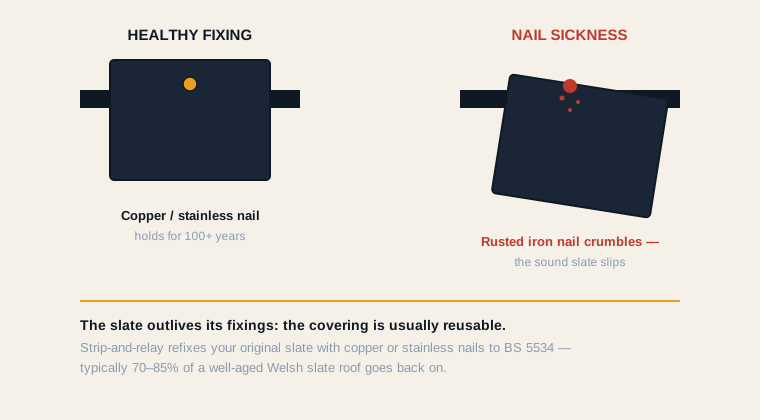
When it isn’t the answer: If the covering is sound period slate with only nail or lead failure, a re-fix and re-lead is far cheaper than a full re-roof Read the full guide.
We inspect the roof in person — covering, timbers, access and the specifics of your Brighton property — so the price reflects your actual roof, not a template.
You get a fixed, written, itemised quote: materials, labour, access and waste separated out, with nothing hidden and no call-out fee.
We walk you through exactly what the price covers — and flag anything that could move it, so there are no surprises later.
We book a start date, arrange any scaffold or skip, and carry out the work when we say we will, keeping you posted throughout.
We clear the site, walk the finished roof with you, and hand over the written 10-year workmanship guarantee.
| Job | Typical duration |
|---|---|
| Terraced house re-roof | 4–6 days |
| 3-bed semi re-roof | 5–8 days |
| Detached / complex roof | 8–12 days |
| Strip, felt, batten & re-cover (per slope) | 2–3 days |
| Structural timber repair (added) | +1–2 days |
Programmes flex for weather — we never strip more than we can make watertight the same day, and phase the work to keep the house covered.
A full re-roof always needs scaffold to a safe working platform and edge protection around the roof perimeter. Scaffold is specified for the whole job — full perimeter scaffold and edge protection are standard on any re-roof — always itemised in your written quote, never a hidden extra, and we arrange it.
Pavement scaffold and skip permits in Brighton go through Brighton & Hove City Council; allow a few working days on tight, parked streets like the Regency terraces of Kemp Town, the tight Victorian streets off Lewes Road and the seafront squares of Hove.
Our workmanship is guaranteed for 10 years in writing, and it’s transferable if you sell.
If a fault appears in covered work, we come back and put it right — no quibbling, no re-charge.
Skips, scaffold and several days of activity — we protect the grounds, keep the house weathertight throughout, and clear the site fully on completion. You don’t need to be home for external work — we just need power and access agreed in advance.
We re-roof through most of the year but plan strips around dry windows; each day's opening is made watertight before we leave site. Brighton's coastal position brings salt-laden wind, strong UV and driving rain off the Channel, which is hard on exposed roofs and tends to speed up wear.
A new roof in Brighton typically costs £5,500–£25,000 in 2026. A standard terraced property runs £5,500–£9,000 in concrete tile, a semi £7,500–£14,000 depending on material, and a detached or conservation-area property £13,000–£25,000. Sussex labour rates run 20–30% above the national average.
In Brighton's 30+ conservation areas, visible materials must match the original — handmade clay tile or Welsh slate rather than economical concrete. This adds 20–40% to the cost. Brunswick Town, Kemp Town, Hanover and Montpelier all carry this premium, and listed buildings require even stricter specification.
Yes. Safe access for work at height is a legal requirement, so scaffolding appears on every genuine re-roof quote. On Brighton's narrow terraced streets, a pavement licence from Brighton & Hove City Council is often needed too, typically adding £150–£400. If a quote has no scaffold line, ask why.
Repair is cheaper when damage is localised and the surrounding structure is sound. Replacement is more cost-effective when the covering is widely failing, nail sickness is extensive, or repeated repairs are no longer holding. On Brighton's post-war concrete-tile estates, widespread nail sickness often tips the balance toward replacement.
In Brighton's coastal conditions, concrete tile lasts 30–50 years, clay plain tile 60–100 years, and Welsh slate 80–100+ years. Salt air shortens the life of concrete tile and lead most, while clay and slate are largely unaffected, giving period properties a real longevity advantage.
A like-for-like replacement is permitted development and does not need planning permission, though it must meet current Building Regulations. Listed buildings need Listed Building Consent, and some conservation areas have Article 4 directions that remove permitted-development rights. We advise on this during the free survey.
Our written quotes itemise strip and disposal, membrane, battens, covering material, all leadwork, ridge and hip, scaffold and any pavement licence, waste removal, timeline, payment terms and guarantee. Everything is priced separately so you can see exactly what you're paying for, with no surprises on the day.
Free survey, written quote, no call-out fee. NFRC registered and fully insured, with a 10-year guarantee on all work across Brighton and East Sussex.
01273 973 996Open 8am daily · 24/7 emergency line · Call 01273 973 996
Weighing up materials? These plain-English Brighton guides compare the options side by side on lifespan, cost and looks.
© Brighton Roofing Experts · Brighton, East Sussex · 01273 973 996
NFRC Registered · Fully Insured · 10-Year Guarantee