EPDM vs GRP: Which Flat Roof Is Right for Your Brighton Home?
EPDM (a single-ply rubber membrane) and GRP (glass-reinforced plastic, or fibreglass) are the two flat-roof systems we fit most often in Brighton, and both comfortably outlast the felt they usually replace. The right choice comes down to the roof's size, whether it is walked on, and how exposed it is to the coast.
Tell us the job in 30 seconds. No pushy sales, no call-out fee.
20+
Years Local
127
5★ Reviews
24/7
Emergency
10yr
Guarantee
For most Brighton flat roofs, EPDM rubber is the better all-rounder — flexible, UV-stable and forgiving on larger or exposed roofs. GRP fibreglass wins where the roof is small, walked on, or wants a hard, seamless finish. Both far outlast old felt.
✓ NFRC Registered
✓ Fully Insured
✓ 10 Year Guarantee
✓ Free Quotes
✓ No Hidden Costs
✓ Coastal Specialists
At a glance
EPDM vs GRP: Side by Side
EPDM (a single-ply rubber membrane) and GRP (glass-reinforced plastic, or fibreglass) are the two flat-roof systems we fit most often in Brighton, and both comfortably outlast the felt they usually replace. The right choice comes down to the roof's size, whether it is walked on, and how exposed it is to the coast.
Neither is simply ‘better’ — each wins in different situations, and the table below sets the two side by side before we get into detail and what each means for a Brighton roof specifically.
Aspect
EPDM
GRP
Typical lifespan
25–40+ years
20–30 years
Installed cost (indicative)
£80–£110/m²
£90–£120/m²
Finish
Matte black rubber membrane
Hard seamless laminate, any colour topcoat
Flexibility
Excellent — stays flexible in cold
Rigid — can craze on large flexing spans
Foot traffic
Fine occasionally; not a terrace surface
Very hard-wearing — good for roof terraces
Joints
Seamless on smaller roofs; bonded seams on larger
Fully seamless once cured
Install
Cold-applied, no flame
Wet lay-up, needs dry, warmer weather
Repairs
Simple patch/bond
Grind and re-laminate — more involved
EPDM
EPDM
Where EPDM shines
EPDM is a flexible rubber sheet bonded to the deck. It handles thermal movement without cracking, shrugs off UV and ozone, and on a modest roof can go down as a single seamless piece. It is cold-applied, so there is no torch on your roof — a real plus over a Brighton conversion or extension.
The trade-offs
It is matte black and not intended as a walking surface, so it is less suited to a roof terrace. On very large roofs the seams are bonded rather than continuous, though done properly they are entirely watertight.
Detailing and edges
EPDM is trimmed with metal or bonded kerb detailing at the edges and around any upstands, rooflights or pipes. On a Brighton roof the edge and upstand detailing is where wind-driven rain is defeated, so we take as much care there as on the field of the roof — a membrane is only as good as its perimeter.
GRP
GRP
Where GRP shines
GRP cures to a hard, glossy, fully seamless laminate that can be topcoated in any colour and walked on freely — ideal for a balcony or roof terrace, which Brighton's converted townhouses often have. Crisp fibreglass trims give a very tidy edge detail.
The trade-offs
It is rigid, so on a large roof that flexes it can craze or hairline-crack over time, and it needs dry, reasonably warm conditions to cure — which can push a Brighton winter job back a few days. Repairs mean grinding back and re-laminating.
Detailing and edges
GRP's fibreglass trims give a crisp, hard edge that many homeowners prefer the look of, and it laps seamlessly into upstands and around rooflights. Because it cures rigid, the bond to a sound, dry, well-fixed deck is critical — which is why deck preparation is a big part of a good GRP job.
Honest advice
Which Is Right for You?
The honest answer depends on your roof, not on which we would rather fit — both are excellent when matched correctly.
Choose EPDM for a larger, flatter or exposed roof, or where you want a cold, flame-free install.
Choose GRP for a small roof, a balcony or terrace you will walk on, or where you want a coloured, hard finish.
Either beats re-covering in felt, which typically lasts half as long.
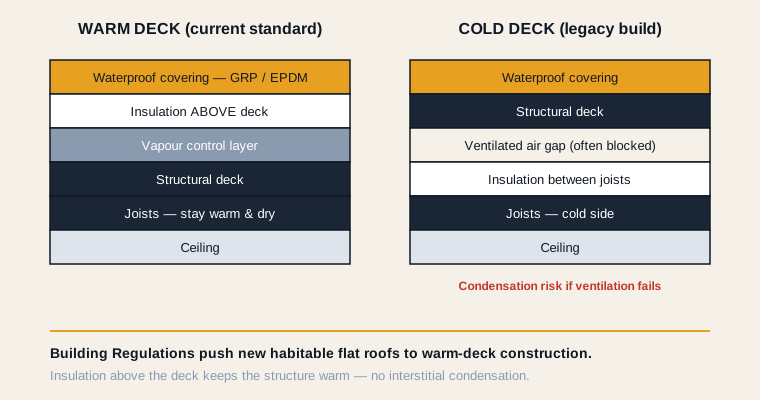
Warm deck vs cold deck — where the insulation sits changes how a flat roof performs.
Local knowledge
EPDM vs GRP in Brighton
Brighton's flat roofs take a beating — salt-laden wind off the Channel, strong UV in summer and driving rain. EPDM's flexibility and UV resistance make it our default on exposed roofs and larger 1960s-block flat roofs, while GRP's hard, walkable finish suits the roof terraces and small rear extensions common on Hove and Kemp Town conversions. On any exposed Brighton roof, edge detailing and wind-uplift fixing matter as much as the membrane itself.
Many Brighton flat roofs also sit below the eyeline of a taller neighbour or a terrace above, so appearance and a reliable, low-maintenance surface matter. Where a roof is overlooked or walked past daily, GRP's tidy coloured finish appeals; where it's out of sight and exposed, EPDM's resilience usually wins on merit.
Costs
EPDM vs GRP: What It Costs in Brighton
Aspect
EPDM
GRP
Small extension roof (up to 15m²)
£1,200–£1,800
£1,400–£2,000
Typical rear-extension / garage
£1,800–£3,000
£2,000–£3,300
Larger flat roof / small block
£3,000–£6,000+
£3,300–£6,500+
Roof terrace / balcony (walkable)
Not ideal
£2,200–£4,000
Indicative Brighton pricing including tear-off, new deck where needed and trims. Every quote follows a free survey. No deposit; staged payments with nothing before materials are on site.
What affects your quote
Roof size and complexity — upstands, rooflights and pipes add labour
Condition of the existing deck — overlay if sound, renew if soft
Access and whether the old covering must be stripped and skipped
Insulation — upgrading to a warm deck adds cost but cuts heat loss
Extras like a walkable finish, a rooflight or a new outlet
How we fit it
What to Expect When We Do the Work
Either way the job runs the same: a free survey to check the deck and detail the roof, a fixed written quote, then strip (or overlay), any deck repair, insulation where wanted, the membrane, and full edge and upstand detailing — signed off with the 10-year workmanship guarantee.
The bottom line
The Bottom Line for Brighton
For a typical Brighton flat roof — an exposed extension or a 1960s-block roof — EPDM is our usual recommendation for its flexibility and coastal resilience. For a small roof or a walkable terrace on a Hove or Kemp Town conversion, GRP earns its place. Have us survey it and we'll recommend for your roof, in writing, with no pressure either way.
FAQ
Frequently Asked Questions
EPDM typically lasts 25–40+ years and GRP around 20–30. Both far outlast felt. On exposed Brighton roofs EPDM's flexibility often gives it the edge over the very long term, as it moves with the roof rather than resisting it.
GRP. Its hard, seamless laminate is made to be walked on and can be finished with anti-slip. EPDM is a weatherproofing membrane rather than a wearing surface, so for a Brighton balcony or terrace we'd normally recommend GRP.
EPDM, yes — it's cold-applied and not weather-critical to cure. GRP needs dry, reasonably warm conditions to cure properly, so a Brighton winter job may wait for a suitable window. We'll advise honestly at survey.
For a larger or exposed roof, EPDM usually gives the best cost-per-year. For a small roof or a walkable terrace, GRP's hard finish justifies its slightly higher cost. Neither is dear next to re-felting every 10–15 years.
Only if the existing deck is soft or rotten. We check it at survey; often the boards are sound and we simply overlay. Where the deck has failed — common under an old, leaking felt roof — we renew it, and that's itemised separately.
GRP pairs naturally with a walkable terrace. Both work around a rooflight; we flash the upstands correctly for the system. If you're planning a terrace or Velux, mention it at survey so we detail the roof for it.
Both, roughly evenly — it genuinely depends on the roof. Exposed and larger roofs tend to get EPDM; small roofs and terraces tend to get GRP. We recommend by the roof in front of us, not by preference.
Sometimes — if the existing deck and covering are sound and level, an overlay saves stripping. More often, an old Brighton felt roof hides a soft deck, so we check first and only overlay where it's genuinely sound. Building the roof on a bad deck is a false economy we won't do.
Yes — our workmanship is guaranteed for 10 years in writing, and the membrane materials carry their own manufacturer warranties on top (terms vary by product). We hand over both at sign-off, and the workmanship guarantee is transferable if you sell.
The honest way is a free survey. We look at your actual Brighton roof — its size, condition, pitch, aspect and setting — and recommend the option that genuinely fits, in writing, with both costed if it's a real choice. There's no obligation to book the work, and we'd rather you chose right than chose dear.