Felt vs Fibreglass: Is It Worth Upgrading Your Brighton Flat Roof?
Traditional built-up felt is the flat roof most Brighton homes still have over an extension or garage, and it's the one that keeps leaking as it ages. Fibreglass (GRP) is the modern upgrade. The real question isn't which is 'better' — it's whether it's worth spending more now to stop replacing the roof every decade.
Tell us the job in 30 seconds. No pushy sales, no call-out fee.
20+
Years Local
127
5★ Reviews
24/7
Emergency
10yr
Guarantee
If your Brighton felt roof is failing, upgrading to fibreglass (GRP) is almost always worth it: it lasts two to three times as long, is seamless and walkable, and ends the cycle of patching. Felt only wins on lowest upfront cost — a false economy on a roof you'll re-do in a decade.
✓ NFRC Registered
✓ Fully Insured
✓ 10 Year Guarantee
✓ Free Quotes
✓ No Hidden Costs
✓ Coastal Specialists
At a glance
Felt vs Fibreglass (GRP): Side by Side
Traditional built-up felt is the flat roof most Brighton homes still have over an extension or garage, and it's the one that keeps leaking as it ages. Fibreglass (GRP) is the modern upgrade. The real question isn't which is 'better' — it's whether it's worth spending more now to stop replacing the roof every decade.
Neither is simply ‘better’ — each wins in different situations, and the table below sets the two side by side before we get into detail and what each means for a Brighton roof specifically.
Aspect
Felt
Fibreglass (GRP)
Typical lifespan
10–20 years
20–30 years
Installed cost (indicative)
£40–£70/m²
£90–£120/m²
Finish
Mineral or plain bitumen, layered
Hard seamless laminate, any colour
Joints
Overlapped layers — a weak point
Fully seamless
Foot traffic
Soft; damages easily
Hard-wearing; walkable
Install
Torch-on (flame) or pour-and-roll
Cold wet lay-up, dry weather
Failure mode
Blisters, cracks, seam splits
Rare; hairline crazing over decades
Repairs
Cheap but frequent
Infrequent; grind and re-laminate
Felt
Felt
Where felt still makes sense
Felt's one advantage is upfront cost — it's the cheapest flat roof to lay. On a low-value outbuilding, or as a short-term fix on a roof you'll rebuild soon, that can be the pragmatic choice. Modern torch-on felt is better than the old pour-and-roll, lasting perhaps 15–20 years.
Why it keeps leaking
Felt is layered, so its seams and laps are inherent weak points, and bitumen goes brittle with UV and age — blistering, cracking and splitting at the joints. On a Brighton roof with full sun and salt wind, that ageing runs faster.
When felt is genuinely fine
On a shed, a detached garage or an outbuilding you don't heat, a good torch-on felt roof is perfectly serviceable and the sensible spend — there's no need to gold-plate a roof over a lawnmower. We'll say so rather than upsell you a fibreglass roof you don't need.
Fibreglass (GRP)
Fibreglass (GRP)
Why fibreglass is the upgrade
GRP cures to one continuous, jointless shell with no seams to fail. It's hard, walkable and can be any colour, and it typically lasts 20–30 years — two to three times a felt roof. For most homeowners it ends the patch-it-again cycle for good.
The trade-offs
It costs more upfront and needs dry, warmer weather to cure, so a winter job may wait for a window. On a very large flexing roof, EPDM rubber can be a better fit than GRP — we'll say so if that's your roof.
What the upgrade actually gets you
Beyond the longer life, fibreglass ends the recurring cost and hassle of felt: no more blisters to chase, no seams to split, no annual worry before winter. On a roof over a kitchen, bathroom or bedroom, that reliability is usually worth more than the upfront saving felt offers.
Honest advice
Which Is Right for You?
Upgrading is usually worth it — but not on every roof, and we'll tell you honestly which yours is.
Upgrade to GRP if the roof is on habitable space, you're tired of leaks, or you'll keep the house a while — the cost-per-year is far lower.
Stick with felt only for a low-value outbuilding or a genuine short-term fix before a bigger project.
If the roof is large or flexes, ask us about EPDM rubber rather than GRP.
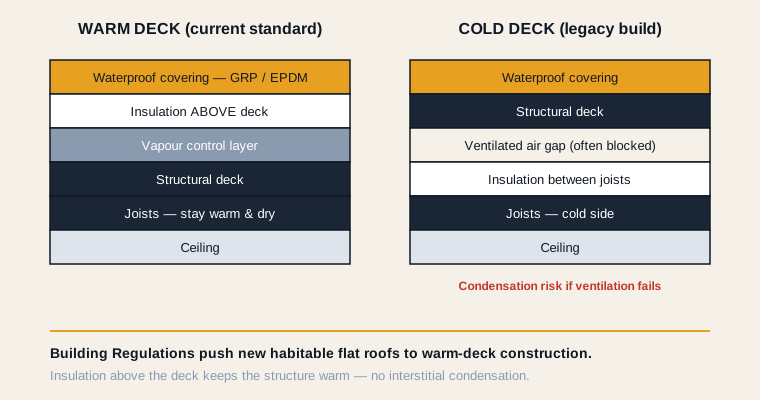
Warm deck vs cold deck — where the insulation sits changes how a flat roof performs.
Local knowledge
Felt vs Fibreglass (GRP) in Brighton
A great many Brighton and Hove flat roofs — Victorian rear extensions, garages, 1960s additions — are on their second or third felt covering and leaking again. Because Brighton's coastal UV and salt wind age bitumen quickly, the felt-patch cycle tends to be shorter here than inland, which is exactly why upgrading to a seamless GRP (or EPDM) system pays off. We'll check the deck underneath at survey — years of felt leaks often leave the boards soft.
Because so many Brighton extensions were felted decades ago, we often find two or three old layers and a tired deck underneath — which is why we survey before quoting rather than guessing. It also means the honest comparison isn't felt-now vs GRP-now, but one more short-lived felt roof against a covering that should see you out.
Costs
Felt vs Fibreglass (GRP): What It Costs in Brighton
Aspect
Felt
Fibreglass (GRP)
Re-felt a small extension
£900–£1,500
—
GRP a small extension
—
£1,400–£2,000
Re-felt typical rear extension
£1,300–£2,200
—
GRP typical rear extension
—
£2,000–£3,300
Cost per year (rough)
~£110/yr
~£85/yr
Indicative Brighton pricing including tear-off and deck repair where needed. Cost-per-year shows why the cheaper roof is often the dearer one. Free survey; no deposit, nothing before materials are on site.
What affects your quote
What's under the felt — sound deck (overlay) or soft boards (renew)
Roof size and the number of upstands, outlets and rooflights
Stripping and disposing of old, sometimes multi-layer, felt
Whether you upgrade the insulation while the roof is open
Access over a conservatory, extension or awkward return
How we fit it
What to Expect When We Do the Work
Whichever you choose, the job is a free survey and deck check first, a fixed written quote, then strip, deck repair where needed, insulation if you're upgrading, the new covering and full detailing — typically a day or two, external only, cleared and signed off with a written guarantee.
The bottom line
The Bottom Line for Brighton
If your Brighton felt roof is over living space and failing, upgrade — fibreglass (or EPDM on a larger roof) costs more today but far less over the years, and ends the leaks. If it's a sound roof over an outbuilding, felt is fine. We'll survey it and tell you honestly which camp yours is in, rather than selling you the dearer roof by default.
FAQ
Frequently Asked Questions
On a roof over habitable space, almost always. GRP lasts two to three times as long, so the cost per year is lower despite the higher upfront price — and it ends the repeated leaks and patching that a Brighton felt roof brings.
Modern torch-on felt lasts perhaps 15–20 years; older pour-and-roll often 10–15. Brighton's coastal UV and salt wind tend to shorten that, which is why so many local felt roofs are on their second or third covering.
Sometimes — if it's a single, localised split we can patch it and buy you time, and we'll say so honestly. But once felt is blistering and cracking across the roof, patching is throwing good money after bad, and a re-cover is the sensible spend.
GRP suits small and walkable roofs; EPDM rubber suits larger or exposed ones. Both beat felt. We recommend by the specific roof — see our EPDM vs GRP guide, or just have us survey it.
Possibly. Long-term felt leaks often soften the deck. We check it at survey; if the boards are sound we overlay, and where they've failed we renew them — itemised separately so you can see exactly what you're paying for.
Stripping felt is the messy part, but it's contained to the roof and cleared the same day. Most flat-roof jobs are a day or two, external only — you don't need to be home beyond agreeing access.
Replacing a flat roof like-for-like is maintenance and needs no permission. Adding a roof terrace or changing the roofline can, and in a conservation area there may be constraints — we'll flag anything that applies to your Brighton property.
Not very — it's external work, usually a day or two, with the mess contained to the roof and cleared the same day. You don't need to be home beyond agreeing access, and we sheet and protect the area below where we're stripping the old felt.
It can. A failing felt roof lets water in; replacing it stops that. If you also upgrade to a warm-deck build-up with insulation, it reduces heat loss and the cold-surface condensation that plagues some Brighton extensions. We'll talk through whether that's worth it for your roof.
The honest way is a free survey. We look at your actual Brighton roof — its size, condition, pitch, aspect and setting — and recommend the option that genuinely fits, in writing, with both costed if it's a real choice. There's no obligation to book the work, and we'd rather you chose right than chose dear.