Emergency roof repairs available 24/7 — Call now: 01273 973 996
⭐ 4.9/5 · 127 Google Reviews · Honest Decision Guide

Should I Repair or ReplaceMy Roof?

An honest decision guide for Brighton homeowners — how age, condition and roof type decide it, the 30% rule of thumb, cost-per-remaining-year logic, and when a replacement quote is oversell. Written by roofers who'll tell you to repair when repair is right.

📞 Call Now: 01273 973 996

Tell us the job in 30 seconds. No pushy sales, no call-out fee.

20+
Years Local
127
5★ Reviews
24/7
Emergency
10yr
Guarantee

Repair if under roughly 30% of the covering has failed and the structure is sound; replace when failure is widespread, the roof is near the end of its material life, or you're repairing it yearly. Age alone doesn't decide it — a 120-year-old slate roof may have decades left. A proper survey settles the question. Call 01273 973 996.

NFRC Registered
Fully Insured
10 Year Guarantee
Free Quotes
No Hidden Costs
Coastal Specialists

Repair or Replace: How to Decide

It's the question every homeowner with an ageing roof faces, and the honest answer is: it depends on three things — how much of the roof has actually failed, how old the covering is relative to its expected life, and whether the structure beneath is sound. Get those three straight and the decision usually makes itself.

The temptation is to think in terms of age alone — "the roof's a hundred years old, it must need replacing." That's often wrong. Brighton is full of Regency and Victorian roofs well over a century old that are performing on their original slate, needing only their nails and lead renewed. Equally, a concrete-tile estate roof half that age can be comprehensively finished. Condition, proportion of failure, and roof type decide it — not the calendar.
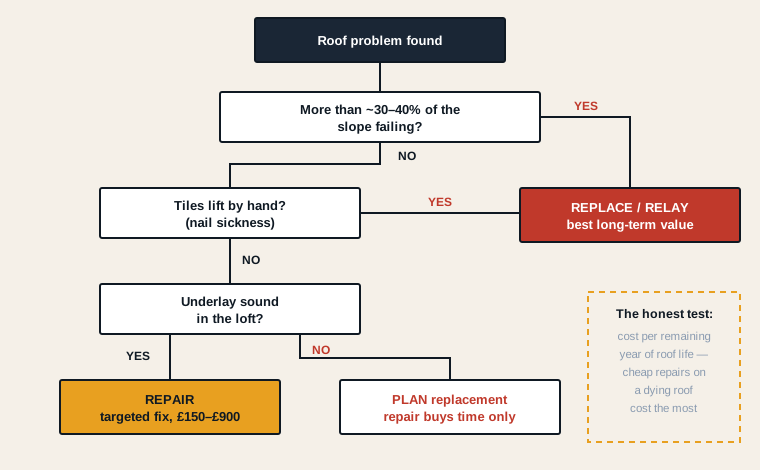
Decision tree: repair or replace a roof, based on proportion failed, covering age and structural condition
A simple decision path: proportion of covering failed, age against expected life, and structural soundness.

Age and Condition by Brighton Stock Era

Every roof covering has an expected service life, and where your roof sits against that life is the starting point. In Brighton's housing:

Brighton's coastal exposure pushes the lower-life coverings toward the shorter end of their range — salt air and wind uplift are unkind to concrete tile and felt in particular. That's a factor in the decision and a reason coastal-grade specification matters on any replacement.

The 30% Rule of Thumb

Roofers have a working rule: once more than about a third of the covering has failed or is actively failing, patch repairs stop making economic sense. The reason is access. Every repair visit carries the cost of getting safely to the roof — towers, ladders or scaffold. When failure is localised, that access cost is spread over a genuine fix. When the roof is giving out generally, you're paying that access cost again and again to chase failures that keep appearing elsewhere, and the running total overtakes the cost of replacing the roof once, properly.

Under roughly 30% failure with a sound structure, targeted repair is almost always right and replacement is oversell. Over it — especially with repeated leaks in different places — replacement usually wins. The figure isn't a law of physics; it's a practical threshold, and a good survey applies judgement around it rather than treating it as a hard line.

Cost-Per-Remaining-Year: The Honest Maths

The most useful way to compare repair and replacement is cost per remaining year of roof life. A £600 repair that buys three more years before the next problem costs £200 a year. A £7,000 re-roof that lasts sixty years costs a little over £100 a year — and gives you six decades without another roofing bill. Framed that way, replacement of a genuinely spent roof is often the cheaper choice over time, even though the upfront number is larger.

But the maths cuts both ways, and this is where honesty matters. If your period slate roof needs £1,200 of re-nailing and re-leading and will then give you another thirty years, that's £40 a year — and spending £12,000 to replace it would be spending money to shorten, not extend, the value you get. We do this calculation with you at survey, using your roof's real condition and remaining life, so the decision rests on figures rather than a sales pitch.

When Replacement Is Oversell

A full re-roof is the biggest-ticket job a roofer can sell, which is exactly why it's the one most often oversold. Be cautious of a replacement quote when:

Our position is simple: we recommend replacement only when a survey can show you the roof genuinely needs it. If it doesn't, we'll tell you, repair it, and leave you with a roof that has years left and money still in your pocket. If you've been quoted a re-roof and it doesn't sit right, get a second opinion — our survey and honest view are free.

Key fact: RICS and BRE stock-condition guidance both stress assessing a roof by element and remaining service life rather than age alone — the basis on which repair-versus-replace should be decided, and the reason a like-for-like age judgement so often misleads.

Applying It to Your Brighton Roof

Brought together, the Brighton picture is this. On the Regency and Victorian slate of Brunswick, Kemp Town, Montpelier and Hanover, the default is repair — these roofs are built to last a century-plus, and their typical failures (nails, lead, individual slates) are repairable; replacement is the exception, justified only by genuine widespread delamination or structural failure. On the post-war concrete-tile estates of Moulsecoomb, Whitehawk, Saltdean and Peacehaven, replacement is far more often the right call — these roofs reach a genuine end of life at 30–50 years, and coastal exposure gets them there sooner.

Wherever your roof sits, the decision should rest on a proper survey — a look at the whole roof at height, an honest assessment of the proportion failed and the remaining life by element, and the cost-per-year maths done transparently with you. That survey is free, and it will tell you honestly whether you're looking at a repair or a replacement. Then you decide, with the full picture and no pressure.

Read alongside this guide: our roof repairs, roof replacement and roof inspection pages, and our new roof cost guide for current Brighton replacement pricing.

Not sure if your Brighton roof needs replacing?

01273 973 996

No call-out fee · Free written quote · NFRC registered

Customer Reviews

What Brighton Homeowners Say

★★★★★

“Two firms quoted me for a full re-roof. These came out, went up, and showed me the concrete tiles really were finished — nail-sick across the whole slope. So I did replace, but only after they proved it. Honest either way.”

Robert W. · Saltdean
★★★★★

“I was braced for a re-roof bill on our Victorian slate. They found it was just nails and a failed valley — re-fixed and re-leaded for a fraction of the cost. Decades of life left, they said. Saved me thousands by being straight.”

Elizabeth W. · Montpelier
★★★★★

“Explained the cost-per-year maths on our estate roof so clearly it made the decision obvious. Replacement genuinely was cheaper over time. No pressure, just the figures. That's rare.”

Pat N. · Hollingbury
FAQ

Frequently Asked Questions

It depends on age, the proportion that's failed, and the roof type. As a rule of thumb, if under about 30% of the covering has failed and the structure is sound, repair. If failure is widespread, the roof is near the end of its material life, or you're repairing it yearly, replacement usually costs less per remaining year. A proper survey settles it.

A widely used rule of thumb: if more than roughly a third of the roof covering has failed or is failing, patch repairs become false economy — you're paying access costs repeatedly to chase a roof that's giving out generally, and replacement is the better value. Under a third, targeted repair is usually right.

By covering: natural Welsh slate 80–100+ years, clay tile 60–100, concrete tile 30–50, and felt flat roofs 15–25 (GRP and EPDM longer). Brighton's salt air and wind exposure push the lower-life coverings toward the shorter end, which is why coastal-grade specification matters on replacement.

Often, yes — age alone isn't the deciding factor. A 120-year-old Welsh slate roof in Brighton may have decades left, with only nails and lead failing; re-fixing and re-leading is far cheaper than replacement. A 40-year-old concrete-tile roof that's nail-sick throughout is the opposite. Condition, not just age, decides.

When a roofer quotes a full re-roof for a roof with serviceable life and localised, repairable failures — especially a sound period slate roof with only nail sickness or failed lead. If a survey can't show you widespread covering failure or structural problems, be cautious about a replacement quote and get a second opinion.

A sound roof protects value and reassures buyers' surveyors, and on period and coastal property a correctly specified new roof removes a common point of sale renegotiation. But replacing a roof that didn't need it doesn't add value — it just spends money. Replace when the roof needs it, not speculatively.

Signs include widespread slipped or delaminated slates or tiles, repeated leaks in different places, sagging, daylight through the roof space, and rising repair frequency. A condition survey with an honest remaining-life estimate per element is the reliable way to know where your roof stands.

More Services

Related Roofing Services in Brighton

Roof Repairs Roof Replacement Roof Inspections New Roof Cost Slate Roofing How We Work
Free Quote

an Honest Roof Assessment in Brighton

Free survey, written quote, no call-out fee. NFRC registered and fully insured, with a 10-year guarantee on all work across Brighton and East Sussex.

01273 973 996

Open 8am daily · 24/7 emergency line · Call 01273 973 996

Last updated: August 2026

© Brighton Roofing Experts · Brighton, East Sussex · 01273 973 996

NFRC Registered · Fully Insured · 10-Year Guarantee

📞 Call Now — Free Quote