Chimney repointing, lead flashing, pot replacement and full stack rebuilds across Brighton and East Sussex. Brighton's Victorian terraces have a chimney on every property — salt air and age make them one of the most common repair calls we receive.
Tell us the job in 30 seconds. No pushy sales, no call-out fee.
Chimney repairs in Brighton cover repointing, lead flashing renewal, pot replacement and rebuilds, typically £150–£800+ depending on access and extent. We use lime mortar on period properties and code 5 lead on exposed positions. All work guaranteed 10 years. Call 01273 973 996 for a free chimney survey.
Brighton's Victorian terraces have an extraordinary density of chimney stacks. Salt air and age create specific problems — here's what we see most often.
Salt crystallisation within mortar joints causes deterioration faster than inland. We use lime-based mortars compatible with Victorian brickwork. Prevents water ingress through the stack. From £250.
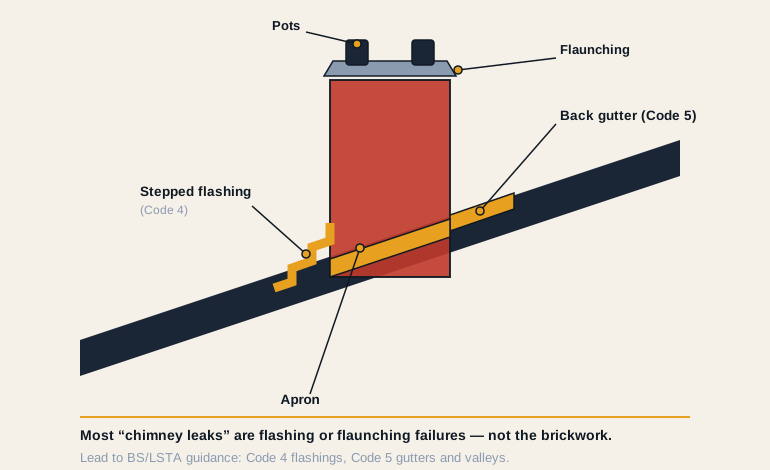
Step flashings and apron flashings around chimney bases are among the most common leak sources in Brighton homes. Salt corrosion accelerates failure. Full replacement rather than patch repairs, done properly. From £300.
The mortar bed around chimney pots fails over time. In Brighton's coastal conditions it typically needs attention every 15–20 years. Loose pots are also a safety concern in high winds. From £150.
Cracked or dislodged chimney pots — a common call after Channel storms. We carry standard pot profiles and can source period-matched styles for conservation area properties. From £120 per pot.
When repointing isn't sufficient — severely deteriorated stacks need full or partial rebuilding. We work to period-appropriate specifications on Victorian and Regency properties. From £1,500.
For disused flues, a chimney cap or cowl prevents rain entry and damp without affecting the stack's structural integrity or appearance. From £200.
Call now for a free, no-obligation quote. No call-out fees.
Walk along any street in Hanover, Elm Grove, Preston Park or Kemp Town and you'll see a chimney stack on every roofline. Brighton's Victorian terraces were built when coal heating was universal, giving the city an extraordinary density of chimney stacks — many now over 120 years old. Even where the fireplaces are no longer used, these stacks remain fully exposed to the weather and require periodic maintenance.
Salt air from the Channel is the dominant factor in Brighton chimney deterioration. Salt particles carried in the sea breeze penetrate mortar joints and crystallise as they dry — a process that physically fractures mortar from within. Lime mortar, which is what most Victorian stacks were originally built with, is more permeable than cement and therefore more vulnerable. Repointing with cement mortar is not the answer — the rigidity of cement causes the brickwork to crack rather than the mortar. We always use hydraulic lime mixes on Victorian and Edwardian stacks.
We inspect from roof level, advise on condition and provide a written quote with no obligation.
📞 01273 973 996
Mon–Fri 8am – 6pm · Sat 8am – 2pm
Emergency: 24/7
"Repointing on our Victorian terrace chimney had been needed for years. They used the right lime mortar, not cement. The stack looks completely solid again and the chronic damp patch in the top bedroom has gone."
"Pot came down in a storm at 2am. They answered the emergency line straight away, came out the next morning, replaced the pot and resealed the flaunching on all four pots while they were up there. Very thorough."
"Lead flashing around the chimney was the source of a persistent bedroom ceiling stain. Fully replaced, not patched. Two winters later and it's perfectly dry. Worth every penny."
Every job follows the same clear process — no surprises, no hidden costs, full communication throughout.
Roof-level inspection of all four faces of the chimney stack. Lead, mortar, pot and structural condition all assessed. Photographs taken of all findings.
We specify the correct mortar type (lime or OPC depending on age of property), lead code, and work required. We advise on conservation area or listed building consent if applicable.
Safe access arranged for all chimney work. Pavement licensing where required for terrace properties.
Repointing with correct mortar mix. Lead replacement dressed in sections no longer than 1.5m with correct thermal movement allowance. Patination oil applied on completion.
10-year written workmanship guarantee. Written completion report documenting all work carried out.
Chimneys take the full force of the weather and are a common leak source — the flashing where lead meets brick usually fails before the stack itself. We see the same early signs again and again on Brighton roofs.
The signs worth acting on:
When it is not the answer: If the stack is redundant and beyond economic repair, removing it below roofline and making good can be the better-value option — see our guide.
Brighton's Victorian and Edwardian chimneys face the combined challenges of age, coastal salt air and the specific knowledge requirements of period masonry. The city's housing diversity — from Regency seafront terraces to 1970s estate housing — means every chimney repairs requires specific local knowledge.
Brighton & Hove has over 30 conservation areas including Brunswick Town, Kemp Town, Hanover and the central Victorian streets. In these areas, chimney repointing and lead work must use materials that match what is currently on the property. We advise on conservation area requirements and source matching materials for every affected job.
Brighton's Channel-facing position means salt air, coastal UV and the thermal cycling driven by sea temperature differentials all affect material performance. We specify materials appropriate to each property's specific coastal exposure — not one-size-fits-all inland specifications.
We cover all of Brighton, Hove and East Sussex. For emergency work, we aim to reach any Brighton property within 2-4 hours. For planned chimney repairs, we typically carry out a free survey within 48-72 hours of your call and provide a written quote the same day or within 24 hours of the survey.
Every Brighton roof is different, but these are the durations we quote most often:
| Job | Typical duration |
|---|---|
| Re-point a stack | Half to a full day |
| Renew lead flashing & soakers | Half to a full day |
| Rebuild the top few courses | 1–2 days |
| Full stack rebuild | 2–3 days |
| Remove stack & make good | 1–2 days |
Around Brighton, mortar and flaunching need dry conditions to cure, so stack work is planned around the forecast.
On Brighton roofs, chimney work almost always needs scaffold or a tower with a chimney platform — the stack cannot be worked safely from a ladder. Scaffold is specified for almost all stack work — a chimney needs a safe standing platform, not a ladder — always itemised in your written quote, never a hidden extra, and we arrange it.
In Brighton, Brighton's stock runs from Regency and Victorian seafront terraces to inter-war and post-war suburban semis, so access ranges from tight city-centre returns to open plots. Pavement scaffold and skip permits go through Brighton & Hove City Council; allow a few working days on streets like Elm Grove, Dyke Road, Preston Drove where space is tight.
These are realistic Brighton price ranges — fixed in writing after a free survey, with no call-out fee:
| Job | Typical range | Notes |
|---|---|---|
| Re-point a stack | £250–£500 | Access dependent |
| Renew lead flashing & soakers | £300–£650 | Per stack |
| Rebuild top courses & re-flaunch | £400–£800 | Incl. pots reset |
| Full stack rebuild | £900–£1,800 | Brick & lead |
| Remove stack & make good | £600–£1,200 | Below roofline |
Worked example: A re-point and new lead flashing on a Victorian terrace off Elm Grove typically runs around £650, including access and waste.
For Brighton homeowners: no deposit on pointing or flashing under £500; staged terms on rebuilds, materials first.
On Brighton roofs, our workmanship is backed by a written 10-year guarantee, with manufacturer warranties on materials on top — in writing, every time.
If a fault appears in covered work, we come back and put it right — no quibbling, no re-charge.
For a Brighton home, expect this: scaffold to the stack and some brick and mortar debris — sheeted and cleared, with the fireplace protected if the flue is worked. You do not need to stay home for external work — we just need power and access agreed in advance.
We plan pointing and flaunching for dry spells so the mortar cures; flashing renewal is more weather-tolerant. Locally, Brighton's seafront exposure brings salt-laden air and Channel gales that corrode lead and fixings faster than inland, while the hillier northern suburbs catch wind straight off the Downs.
Repointing a standard Victorian chimney stack in Brighton typically costs £250–£600 depending on height and extent of work. Full stack rebuilds start from £1,500. Free survey and written quote on every job.
No — and this is a common and expensive mistake. Cement mortar is too rigid for Victorian brickwork. As the building moves, the bricks crack rather than the mortar joints. We always use hydraulic lime on Victorian and Edwardian stacks.
Yes. A disused chimney is still fully exposed to weather and deteriorates in the same way. Water ingress through a disused stack is actually more common because there's no heat inside to drive moisture out. Cap unused stacks properly, or maintain the pointing and flaunching.
Damp patches on the ceiling or wall near the chimney breast, or visible separation between the flashing and the chimney stack when viewed from ground level, are the main signs. If in doubt, call us — we'll check from roof level and tell you exactly what's needed.
We inspect from roof level, give you an honest assessment, and quote in writing. No call-out fee.
01273 973 996