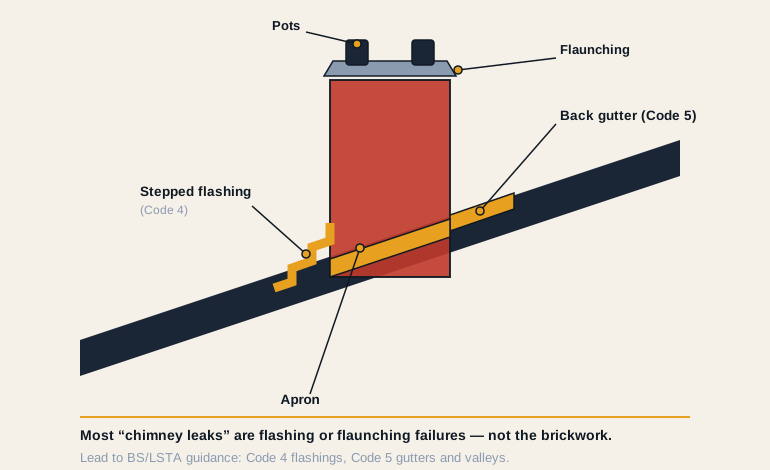
The most common repair we carry out in Brighton. Salt air from the Channel corrodes lead flashings faster than anywhere inland — step flashings, apron flashings and valley linings on Brighton's Victorian chimneys all deteriorate at an accelerated rate. Diagnosis, repair and full replacement across Brighton and East Sussex. Free quotes, no call-out fee.
Tell us the job in 30 seconds. No pushy sales, no call-out fee.
Lead flashing services in Brighton cover chimney, valley and abutment lead, typically £200–£900 depending on position and extent. We use code 5 lead for exposed coastal positions and apply patination oil to prevent staining. All work carries a 10-year guarantee. Call 01273 973 996 for a free survey.
Lead flashing is the waterproof seal between your roof and any vertical surface. When it fails, water tracks into the building. These are the types we repair most often in Brighton.
Interlocking lead pieces that seal the joint between a chimney stack and the roof slope. The most common failure point on Brighton's Victorian terraces — salt corrosion splits the soakers and step pieces within 20–30 years. Full replacement from £350.
The lead sheet sealing the front face of the chimney where it meets the roof. Particularly vulnerable on south-west-facing properties exposed to Channel rain. From £200.
Lead valleys channel water from two roof planes. Coastal salt accelerates oxidation and debris accumulation causes ponding that worsens the damage. Full valley re-lining from £400.
Where a roof meets a wall — party walls, dormer sides, extension joints. Particularly common on Brighton's terraced properties where roof planes adjoin neighbouring walls. From £250.
Lead upstand flashings where a flat roof meets a wall or parapet. Common on rear extensions of Brighton's Victorian terraces. Often fails before the flat roof membrane itself. From £200.
Individual lead soakers beneath each tile course at chimney or wall junctions. When soakers corrode — common after 25–30 years in coastal Brighton — full replacement is the only proper fix. From £300.
Call now for a free, no-obligation quote. No call-out fees.
Brighton sits directly on the English Channel, and the prevailing south-westerly wind carries salt particles continuously inland. Those salt particles deposit on lead surfaces and initiate an electrochemical corrosion process that is significantly faster than the weathering lead undergoes in inland towns. On a Farnham or Guildford property, lead chimney flashings might last 40–50 years before failure. On an equivalent Brighton property — particularly one within a mile of the seafront — the same flashings may begin failing at 20–30 years.
The problem is most acute on properties facing south or south-west, where Channel rain driven by prevailing winds impacts the lead directly. Kemp Town, Brunswick and Hove seafront properties are most exposed. Even inland Brighton properties — Hanover, Preston Park, Fiveways — experience faster lead corrosion than Surrey or Hampshire equivalents. The practical implication: Brighton homeowners should inspect lead flashings every 5 years, not the 10-year interval that applies inland.
Damp patches or water staining near a chimney breast. Visible separation or lifting of lead from masonry. White salt deposits (efflorescence) on the lead surface. Cracking or splitting at stress points. Any of these means the flashing needs inspection — call us and we will assess from roof level at no charge.
"Persistent damp above chimney breast — blamed on the pot, the render, then the gutters. These guys found the step flashings had corroded through. Replacement sorted it immediately."
"Previous roofer patched the lead twice. Both patches failed within two winters. Brighton Roofing replaced the lot with new code 5 lead. Completely dry for three years."
"Valley relining on our Victorian terrace. Stripped old lead, cleared 30 years of debris, re-lined with new. The valley drains properly for the first time in years."
Every job follows the same clear process — no surprises, no hidden costs, full communication throughout.
Roof-level inspection of all lead flashings — step, apron, valley, abutment. Salt corrosion assessment. Photographs of all findings.
We specify code 4 or 5 lead as appropriate to the position and exposure. We advise on patching vs full replacement — in coastal conditions, full replacement is almost always more cost-effective.
All existing lead removed. Masonry and tile surfaces cleaned. Any underlying mortar or tile damage repaired before lead installation.
New lead dressed in sections no longer than 1.5m. Fixed with lead tacks into correct mortar joints. All joints lapped and dressed. Patination oil applied on completion.
All lead work carries a written 10-year workmanship guarantee. Lead should not be the source of any future roof leak within that period.
Lead flashing seals the junctions where the roof meets a wall, chimney, valley or rooflight — and near the coast it corrodes and fails faster than inland. We see the same early signs again and again on Brighton roofs.
The signs worth acting on:
When it is not the answer: If existing lead is sound and simply lifted from its chase, re-dressing and re-pointing it is enough — full renewal is not always needed — see our guide.
Lead flashing failure is the single most common source of roof leaks on Brighton's older properties. The city's housing diversity — from Regency seafront terraces to 1970s estate housing — means every lead flashing repairs requires specific local knowledge.
Brighton & Hove has over 30 conservation areas including Brunswick Town, Kemp Town, Hanover and the central Victorian streets. In these areas, lead replacement must use materials that match what is currently on the property. We advise on conservation area requirements and source matching materials for every affected job.
Brighton's Channel-facing position means salt air, coastal UV and the thermal cycling driven by sea temperature differentials all affect material performance. We specify materials appropriate to each property's specific coastal exposure — not one-size-fits-all inland specifications.
We cover all of Brighton, Hove and East Sussex. For emergency work, we aim to reach any Brighton property within 2-4 hours. For planned lead flashing repairs, we typically carry out a free survey within 48-72 hours of your call and provide a written quote the same day or within 24 hours of the survey.
Every Brighton roof is different, but these are the durations we quote most often:
| Job | Typical duration |
|---|---|
| Re-dress & re-point lifted lead | 2–4 hours |
| Renew abutment / step flashing | Half a day |
| Renew chimney flashing & soakers | Half to a full day |
| Rebuild a lead valley | 1–2 days |
| Re-lead a parapet gutter (section) | 1–3 days |
Around Brighton, leadwork is fairly weather-tolerant, but pointing the chase into mortar needs a dry window to cure.
On Brighton roofs, flashing at low level can be reached from a tower; chimney, valley and parapet leadwork needs scaffold for safe access. Scaffold is specified for chimney flashing, valley rebuilds and any parapet-gutter leadwork — always itemised in your written quote, never a hidden extra, and we arrange it.
In Brighton, Brighton's stock runs from Regency and Victorian seafront terraces to inter-war and post-war suburban semis, so access ranges from tight city-centre returns to open plots. Pavement scaffold and skip permits go through Brighton & Hove City Council; allow a few working days on streets like Elm Grove, Dyke Road, Preston Drove where space is tight.
These are realistic Brighton price ranges — fixed in writing after a free survey, with no call-out fee:
| Job | Typical range | Notes |
|---|---|---|
| Re-dress & re-point lifted lead | £150–£300 | Per junction |
| Renew abutment / step flashing | £250–£500 | Per elevation |
| Chimney flashing & soakers | £300–£650 | Per stack |
| Rebuild a lead valley | £550–£950 | Incl. new lead |
| Re-lead parapet gutter (per section) | £600–£1,400 | Code 7/8 lead |
Worked example: A rebuilt lead valley on a Victorian terrace off Elm Grove typically runs around £800, including access and waste.
For Brighton homeowners: no deposit on flashing under £500; staged terms on valley and parapet leadwork.
On Brighton roofs, our workmanship is backed by a written 10-year guarantee, with manufacturer warranties on materials on top — in writing, every time.
If a fault appears in covered work, we come back and put it right — no quibbling, no re-charge.
For a Brighton home, expect this: focused work at one or two junctions — little mess, with old lead removed and recycled and the area left clean. You do not need to stay home for external work — we just need power and access agreed in advance.
Lead can be dressed in most conditions; we time the mortar pointing of the chase for dry spells so it holds. Locally, Brighton's seafront exposure brings salt-laden air and Channel gales that corrode lead and fixings faster than inland, while the hillier northern suburbs catch wind straight off the Downs.
Apron flashing repairs from £200. Step flashing replacement £350–£600. Full chimney flashing (step, apron, soakers) £500–£800. Free quotes, no call-out fee.
In Brighton's coastal conditions, patching buys 2–4 years at most. Full replacement is more cost-effective over a 10-year horizon. We'll tell you honestly which situation you're in after inspecting from roof level.
Code 4 or code 5 lead, correctly dressed, should last 30–50 years in coastal conditions. All our lead work carries a 10-year written guarantee.
Every 5 years for Brighton properties — every 3–4 years for seafront or south/west-facing properties. We offer free roof-level inspections.
We inspect from roof level, diagnose the problem and quote in writing. No call-out fee. Code 4 and code 5 lead used throughout.
01273 973 996