⚡ Emergency roof repairs available 24/7 — Call now: 01273 973 996
⭐ 4.9/5 · 127 Google Reviews · Code 4 & 5 Lead Specialists

Lead Flashing in Seaford

Lead flashing failure is the single most common source of roof leaks on Seaford's older properties. Maximum south-westerly exposure — Seven Sisters headland to the east creates a Cuckmere Valley wind funnel that amplifies Channel gales through the town. We replace and repair lead to the correct specification for East Sussex conditions.

20+
Years Local
127
5★ Reviews
24/7
Emergency
10yr
Guarantee
NFRC Registered
Fully Insured
10 Year Guarantee
Free Quotes
No Hidden Costs
Lead Flashing in Seaford

Lead Flashing in Seaford

Wind damage is more frequent and severe here than anywhere else in East Sussex outside Beachy Head. Lead flashing around chimneys, valleys and abutments is the highest-maintenance element of most roofs in Seaford. Maximum south-westerly exposure — Seven Sisters headland to the east creates a Cuckmere Valley wind funnel that amplifies Channel gales through the town. Among the highest wind speed records for any East Sussex residential area. Cuckmere Valley humidity creates damp microclimates on north and east-facing slopes. We inspect and replace lead to the correct code and specification for local conditions.

Why Lead Flashing Fails Faster in East Sussex

Maximum south-westerly exposure — Seven Sisters headland to the east creates a Cuckmere Valley wind funnel that amplifies Channel gales through the town. Among the highest wind speed records for any East Sussex residential area. Cuckmere Valley humidity creates damp microclimates on north and east-facing slopes. This means Brighton and East Sussex homeowners should inspect lead every 5 years rather than the 10-year interval that inland guidance suggests. Patching fails within 2-4 years in coastal conditions — full replacement is the right answer in most cases.

Code 4 vs Code 5 Lead for Seaford Properties

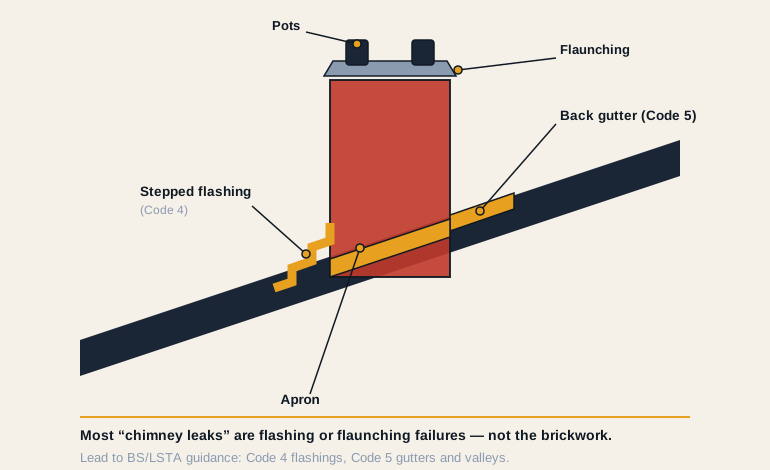
Code 4 lead (1.8mm) is standard for most inland applications. For exposed coastal positions — seafront properties, cliff-top locations, south-facing chimney stacks — code 5 lead (2.24mm) provides meaningfully longer service life. We specify code 5 as standard for exposed positions in Seaford.

Our Lead Flashing Replacement Process

Strip all existing lead. Clean masonry and tile surfaces. Dress new lead in sections no longer than 1.5m to allow thermal movement. Secure with lead tacks into correct mortar joints. Point all joints with lead mortar. Apply patination oil on completion to establish protective surface chemistry. Inspect from roof level and sign off.

Lead Flashing Costs in Seaford
Step flashing replacement (per m)£80 - £150
Chimney apron flashing£200 - £500
Valley lead replacement (per m)£100 - £180
Full chimney flashing set£400 - £900
Lead flashing surveyFree
Call for a Free Quote: 01273 973 996
Customer Reviews

What Seaford Homeowners Say

★★★★★

“Lead around the chimney had been bodged twice before. Full replacement with code 5 lead — two years on and not a drop. Should have done it properly the first time.”

Margaret T. · Broad Street, Seaford
★★★★★

“Valley lead had corroded right through. Replaced the full valley, repointed the adjacent tiles and it looks and works perfectly.”

Ian P. · Sutton Road, Seaford
★★★★★

“Step flashing on a rear extension had lifted in the gales. Replaced and dressed correctly with tacks. Very clear explanation of why the old installation had failed.”

Carol N. · Claremont Road, Seaford
Local Knowledge

What Makes Seaford Different

The Housing Stock

Victorian and Edwardian town centre on Broad Street and Sutton Road, 1930s-50s suburban expansion, cliff-top properties with maximum exposure. Clay plain tile on Victorian stock, concrete interlocking on mid-century expansion. Valley flashings need more frequent inspection than in sheltered positions..

Climate and Exposure

Seven Sisters headland creates a Cuckmere Valley wind funnel amplifying Channel gales. Among the highest wind speed records in East Sussex..

The Key Issue in Seaford

Wind funnelling from the Cuckmere Valley makes Seaford the most storm-exposed town in East Sussex outside Beachy Head. Tile displacement in gales is more frequent here than anywhere else we cover..

Pricing note: Seaford's exposure means dry-fix ridge systems are worth considering — mechanically fixed ridge tiles are significantly more storm-resistant than mortar bedding..

How It Works

Our Lead Flashing Process in Seaford

Every job follows the same clear process — no surprises, no hidden costs, full communication throughout.

1
Free Lead Survey

Roof-level inspection of all lead flashings — step, apron, valley, abutment. Salt corrosion assessment. Photographs of all findings.

2
Specification

We specify code 4 or 5 lead as appropriate to the position and exposure. We advise on patching vs full replacement — in coastal conditions, full replacement is almost always more cost-effective.

3
Strip and Prepare

All existing lead removed. Masonry and tile surfaces cleaned. Any underlying mortar or tile damage repaired before lead installation.

4
Lead Installation

New lead dressed in sections no longer than 1.5m. Fixed with lead tacks into correct mortar joints. All joints lapped and dressed. Patination oil applied on completion.

5
10-Year Guarantee

All lead work carries a written 10-year workmanship guarantee. Lead should not be the source of any future roof leak within that period.

FAQ

Lead Flashing Seaford — Frequently Asked Questions

Step flashing replacement costs £80-150 per linear metre. A full chimney flashing set (step, back and front aprons) costs £400-900 depending on chimney size. Valley lead costs £100-180 per metre. Free surveys and written quotes for all work.

Code 4 or 5 lead correctly installed lasts 30-50 years even in East Sussex's coastal conditions. The key is correct installation — sections short enough to move with thermal expansion, correctly secured with tacks, properly pointed.

In East Sussex's conditions, patching is a short-term measure. The surrounding lead has been subject to the same corrosion process and will fail within 2-4 years of any patch. Full replacement is more cost-effective over a 10-year horizon for most Seaford properties.

Damp patches near a chimney breast; white salt deposits (efflorescence) on the lead surface; visible lifting or separation of lead from brickwork; cracking or splitting at dressed edges; water staining on exterior walls below the chimney or abutment.

Age-related lead failure is usually excluded as a maintenance issue. Storm damage to lead flashing — where it has been displaced by high wind — is usually covered. We provide written reports that support insurance claims for storm-related damage.

Patination oil is applied after lead installation to establish the stable protective patina that prevents run-off staining on walls and tiles beneath. It's a standard part of our lead installation — included in all quotes.

We cover Seaford and the surrounding East Sussex area. Call 01273 973 996 to arrange a free survey.

Further Reading

Related Guides

Why Lead Flashing Fails Faster Near the Coast → Best Roofing Materials for Coastal Properties → Roofing in Brighton Conservation Areas →
SEAFORD

Free Quote for Lead Flashing in Seaford

No call-out fee. No obligation. Honest quote from a local roofer.

01273 973 996

© 2025 Brighton Roofing Experts · Seaford, East Sussex · 01273 973 996

NFRC Registered · Fully Insured · 10-Year Guarantee

📞 Call Now — Free Quote