Whether it’s a Victorian villa off Blatchington Road or a post-war semi, our Hove roof repairs is built to last, quoted in writing, and cleared up properly when we leave.
Tell us the job in 30 seconds. No pushy sales, no call-out fee.
Call now for a free, no-obligation quote. No call-out fees.
Hove's Regency and early Victorian terraces of Brunswick, Palmeira and Adelaide squares — built from the 1820s to 1850s — have shallow-pitched roofs with original Welsh slate, complex lead valley and flashing arrangements, and chimney stacks that require lime mortar. These are among the most architecturally significant domestic roofs in the South East and need a different approach to a standard repair call.
North of the seafront, the Edwardian avenues around Portland Road are predominantly clay or concrete plain tile, now 100+ years old and on their second or third set of tiles. Further north, the 1930s detached properties of Westdene and Hove Park have concrete interlocking tile increasingly showing its age after 80+ years of coastal exposure.
Lead flashing failure at chimney bases on seafront properties — salt corrosion at its most acute. Ridge tile repointing on Victorian and Edwardian properties using lime mortars. Tile replacement on Westdene 1930s–50s stock. Valley relining on the complex Regency roof geometries of Brunswick Town conservation area.
"Welsh slate repair on our Brunswick seafront terrace. They sourced a close match and used lime bedding mortar correctly — not cement. Exactly what the conservation area requires."
"Ridge tile repointing on our Edwardian semi on Portland Road. Lime mortar throughout, clean work, didn't disturb the neighbours. The ridge looks solid for another 30 years."
"Three roofers couldn't find the source of our bedroom ceiling leak. Brighton Roofing identified failed soakers behind the chimney stack within minutes. Fixed properly, stayed dry."
In Hove, most roof repairs jobs announce themselves before you ever get on the roof. Most roof repairs announce themselves indoors before you ever see the roof. Knowing the signs tells you whether you need a repair now or can plan it.
Tell-tale signs on a Hove roof:
When it is not the answer: If more than about a third of the covering has failed or the roof is nail-sick across whole slopes, tile-by-tile repair is money wasted — see our guide.
Regency stucco terraces in Brunswick, Victorian bay-fronted villas along the Avenues, 1930s semis in north Hove. Welsh slate and clay plain tile on period stock. Shallow-pitched Regency roofs behind parapets are a specialist challenge..
Direct Channel exposure from the south. Salt deposition heaviest on south-facing slopes. Conservation area constraints in Brunswick Town..
Regency parapet gutters behind stucco facades block with debris and overflow internally — a problem unique to Hove's seafront architecture..
Pricing note: Conservation area material matching adds 20-40% to Hove job costs versus non-conservation equivalents..
Every job follows the same clear process — no surprises, no hidden costs, full communication throughout.
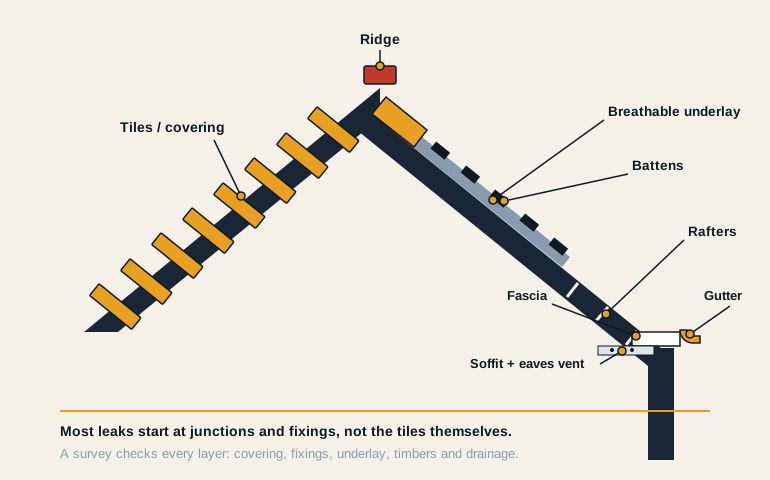
We inspect from roof level — not just binoculars from the ground. We photograph all defects and assess batten, felt and lead condition as well as the visible tile work.
You receive a written report of findings, prioritised by urgency, with a clear written quote specifying materials, method and guarantee period.
We source matching materials for your property type — including clay plain tile and Welsh slate for conservation area properties. We advise on colour and profile matching.
All repair work carried out to manufacturer specification and NFRC standards. No cement mortar on Victorian brickwork. No patch repairs on failing lead where replacement is the right answer.
All repair work carries a 10-year written workmanship guarantee. We walk you through the completed work and leave the site clean.
As a guide to what to expect in Hove, typical job times run:
| Job | Typical duration |
|---|---|
| Slipped or cracked tile refix | 1–2 hours |
| Localised leak trace & repair | Half a day |
| Lead flashing or soaker renewal | Half to a full day |
| Rear valley rebuild | 2–3 days |
| Small section re-cover | 2–4 days |
Around Hove, wet or high-wind days pause tiling and leadwork — we build weather margin into every booking and weatherproof temporarily if rain stops play.
Access shapes every Hove quote: most repairs run from roof ladders or a tower; scaffold is specified only where the job needs safe standing time at height. Scaffold is specified for chimney-side repairs, full valley rebuilds, and anything beyond a day at height — always itemised in your written quote, never a hidden extra, and we arrange it.
In Hove, Hove's mix runs from Victorian villas and mansion blocks to inter-war semis, so access ranges from tight terraced returns to open suburban plots. Pavement scaffold and skip permits go through Brighton & Hove City Council; allow a few working days on streets like Tisbury Road, Blatchington Road, Sackville Road where space is tight.
What you can expect to pay in Hove, before your fixed written quote:
| Job | Typical range | Notes |
|---|---|---|
| Slipped/cracked tile refix | £150–£250 | Per visit, incl. access |
| Localised leak trace & repair | £180–£450 | Depends on cause |
| Lead flashing renewal (per section) | £250–£600 | Chimney or abutment |
| Rear valley rebuild | £550–£950 | Incl. lead & access |
| Small section re-cover | £600–£1,200 | Tiles/slate + battens |
Worked example: A rear valley rebuild on a Victorian villa off Blatchington Road typically runs around £750, including access and waste.
Our Hove terms: no deposit on repairs under £500. Nothing up front before materials are on site.
We're based in Brighton. Not a national lead farm — it's our team on every job across Brighton, Hove and East Sussex.
All our roofing work carries a written 10-year workmanship guarantee. We stand behind every job.
We're registered with the National Federation of Roofing Contractors — verifiable at nfrc.co.uk.
Free surveys, free quotes, no call-out charge for emergency visits. You pay for the work, not the attendance.
The Victorian and Edwardian villas along Hove's tree-lined avenues — Cromwell, Davigdor, New Church Road — were roofed predominantly in clay plain tile. At 100-130 years old, this tile is typically in sound structural condition. The repairs needed are not to the tile itself but to the infrastructure: ridge and hip mortar that has softened after a century; lead flashings around chimney stacks that have been subject to 130 years of coastal humidity; and nail fixings that have corroded through decades of salt air. The correct approach is systematic renewal of these elements while preserving the original tile where it is sound.
Brunswick Town, portions of the Avenues and the area around St Ann's Well Gardens fall within conservation areas. In these areas, visible repair materials must match what is currently on the roof. For the clay plain tile properties on the Avenues, this means sourcing appropriate clay tile that matches the profile and colour of the original installation. Machine-made clay tile is generally acceptable for non-listed properties. For listed buildings in Brunswick, the requirement is more specific — handmade clay from appropriate manufacturers. We advise on this sourcing as part of every Hove survey at no extra charge.
Lead flashings on Hove properties close to the seafront corrode faster than those on equivalent sheltered inland properties. For Brunswick and seafront Hove properties, we recommend lead inspection every 5 years rather than the 10-year interval appropriate for inland towns. The additional inspection cost is minimal relative to the cost of the interior damage that follows undetected lead failure.
Our workmanship is backed by a written 10-year guarantee, with manufacturer warranties on materials on top — the same written cover on every Hove job.
If a fault appears in covered work, we come back and put it right — no quibbling, no re-charge.
For a Hove home, expect this: a day or so of ladder or tower work and a small amount of tile debris — we sheet below the work area and clear before we leave. You do not need to stay home for external work — we just need power and access agreed in advance.
Repairs run year-round; temporary weatherproofing goes on the same day if rain interrupts the work. Locally, Hove's seafront exposure brings salt air and coastal gales, while the tree-lined avenues fill gutters and valleys each autumn.
Minor repairs are typically £150–£400. Lead flashing repairs on seafront properties are £300–£600 due to advanced salt corrosion. Conservation area work requiring specialist materials may cost slightly more. All quotes free, no call-out fee.
Yes. We source appropriate Welsh slate, use lime mortars and understand material constraints in Brunswick Town and other Hove conservation areas.
Yes. Lead flashing repair and replacement on Hove's Victorian and Regency seafront properties is one of our most common jobs.
Yes — 24 hours a day, no call-out fee. Call 01273 973 996 any time.
No call-out fee. Victorian, Regency and period property specialists. Written quote before any work starts.
01273 973 996