Roof repair specialists in Lewes with deep knowledge of the town's historic building stock. Georgian townhouses on the High Street, Victorian terraces off Southover Road, Horsham stone properties in the conservation area — we understand the materials, constraints and correct repair methods for each.
Call now for a free, no-obligation quote. No call-out fees.
Lewes has one of the highest concentrations of listed buildings per capita in East Sussex. The conservation area covering the town centre places material constraints on almost all roofing work. Handmade clay plain tiles must be sourced to match original stock. Lime mortar mixes must be appropriate for the period masonry. Horsham stone slab roofs — found on some of the town's oldest buildings — require specialists who understand the material's behaviour.
Beyond the conservation area, the Victorian terraces off Southover Road, Bradford Road and streets around Lewes station present the standard repair agenda: chimney repointing with hydraulic lime, lead flashing renewal at chimney bases, tile and ridge repairs on roofs now over 100 years old. The Ouse Valley location accelerates moss and organic growth — valley clearing and biocide treatment are regular maintenance calls across all older stock.
Chimney repointing with lime mortar is the most frequent call — both on conservation area properties and Victorian terrace stock. Lead flashing renewal is second, particularly on north and west-facing slopes affected by Ouse Valley moisture.
"Re-pointing on our listed Georgian property on School Hill — full lime mortar, correct specification. The conservation officer raised no concerns. We'd struggled to find anyone who understood the requirements."
"Lead flashing renewal on a Victorian terrace off Southover Road. Explained exactly what was causing the leak, quoted clearly. The repair has held perfectly through two wet winters."
"Horsham stone slab repairs on a cottage near the castle — very specialist work. They knew exactly how to handle it, sourced reclaimed stone to match. Excellent job."
Georgian townhouses on the High Street and Keere Street, Victorian terraces in Southover, Edwardian semis on the Nevill estate. Handmade clay plain tile and Horsham stone slab on historic stock. Conservation area requirements mandate like-for-like matching throughout the Lewes Old Town..
Ouse Valley wind funnelling amplifies Channel gales through the South Downs gap. High Street ridge properties face maximum exposure..
Wind funnelling through the Ouse Valley gap creates storm conditions more severe than equivalent coastal towns. High Street properties lose ridge tiles in storms that cause no damage in Brighton..
Pricing note: Horsham stone is rare and expensive to source — budget for premium material costs on historic Lewes properties..
Every job follows the same clear process — no surprises, no hidden costs, full communication throughout.
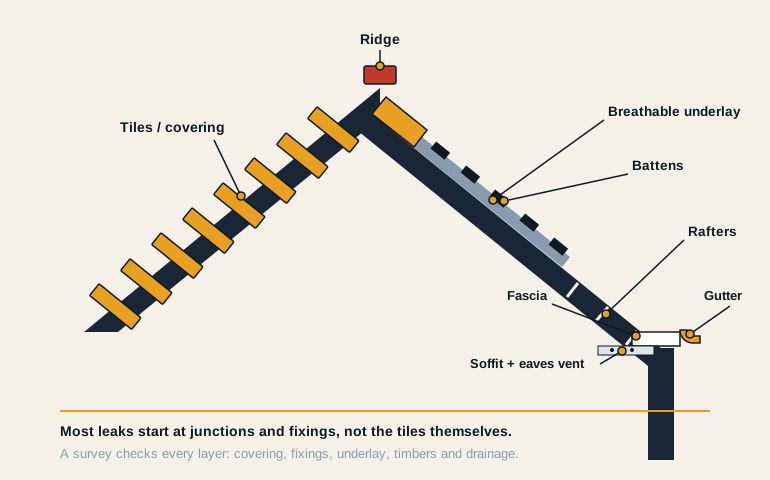
We inspect from roof level — not just binoculars from the ground. We photograph all defects and assess batten, felt and lead condition as well as the visible tile work.
You receive a written report of findings, prioritised by urgency, with a clear written quote specifying materials, method and guarantee period.
We source matching materials for your property type — including clay plain tile and Welsh slate for conservation area properties. We advise on colour and profile matching.
All repair work carried out to manufacturer specification and NFRC standards. No cement mortar on Victorian brickwork. No patch repairs on failing lead where replacement is the right answer.
All repair work carries a 10-year written workmanship guarantee. We walk you through the completed work and leave the site clean.
We're based in Brighton. Not a national lead farm — it's our team on every job across Brighton, Hove and East Sussex.
All our roofing work carries a written 10-year workmanship guarantee. We stand behind every job.
We're registered with the National Federation of Roofing Contractors — verifiable at nfrc.co.uk.
Free surveys, free quotes, no call-out charge for emergency visits. You pay for the work, not the attendance.
A handful of Lewes properties — particularly older farmhouses and some of the earliest buildings in the historic core — retain Horsham stone slab roofing. This sandstone slab, quarried from the Weald, is extraordinarily heavy (up to 4kg per slab) and requires specific knowledge to repair correctly. The slabs are not nailed — they are held by gravity, with smaller slabs at the ridge graduating to larger ones at the eaves. When a slab cracks or slips, it must be replaced with matching stone, correctly lapped and weighted. Horsham stone is no longer quarried commercially; replacement material comes from salvage yards. We know where to source it.
Lewes Old Town conservation area covers the Georgian and Victorian streets where the dominant building material is hand-made brick and flint. OPC cement mortar on these properties causes spalling damage that is irreversible and visually obvious to any conservation officer. Every repair we carry out in Lewes Old Town uses lime mortar of the appropriate specification — hydraulic lime for chimney stacks and ridge work, non-hydraulic lime putty mortar for the most sensitive flint masonry. The specification is confirmed during the survey, not assumed.
Like-for-like repair in Lewes conservation areas does not normally require planning consent. Replacing handmade clay tile with matching handmade clay tile; Welsh slate with Welsh slate; like-for-like lead replacement — these are all permitted development. What does require consent: changing the visible material type, structural alterations, and any work on Grade I or II* listed buildings that affects character. We advise clearly on this during every Lewes survey.
Yes. We have extensive experience with conservation area requirements — sourcing handmade clay plain tiles, using hydraulic lime mortars, working with Horsham stone and Welsh slate.
Minor tile or slate repairs are £150–£400. Lead flashing renewal is £250–£600. Chimney repointing with lime mortar is £300–£700. Conservation area work with specialist materials may cost slightly more.
Yes — always for Victorian and earlier masonry. Using cement mortar on old brickwork causes more damage than it fixes. We always specify the correct mortar mix.
Yes — Ringmer, Glynde, Plumpton, Ditchling, Falmer and surrounding East Sussex villages within approximately 10 miles.
Conservation area specialists. Lime mortar, handmade tile matching, Horsham stone. No call-out fee.
01273 973 996